Showing posts with label community. Show all posts

Monday, July 9, 2018

Interview: Laura Shaeffer

Compound Yellow Workspace, drawing by Madeline Aguilar


Laura Shaeffer
is an artist-organiser cultural producer, and informal educator based in Oak Park, Illinois since 2016. Over the past 20 years, she has worked alone and in collaboration on numerous projects housed within unconventional and often underutilized spaces on the South Side of Chicago, including Home Gallery, The Op Shop and Southside Hub of Production (SHoP) and now, in Oak Park, Compound Yellow. 


She specializes in developing collaborative networks in the arts and other creative endeavors.

"Her approach is a combination of activism and common sense; community building and home-making. She honors domestic spaces as sites of radical, informal pedagogy, and this manifests itself in an important through line that runs across her projects; they act as platforms for kids to express their creativity and imagination, and indulge their curiosity. Alongside immersing them in art and cultural production, an important byproduct of this is kids’ engagement with other kids, families, neighbors and neighborhoods. By remaining open, nurturing organic expansion and leveraging intuition, Shaeffer stewards growth rather than shoehorning artists into rigid themes or mapping them onto discrete timelines."
                                                                                           - Thea Liberty Nichols for Bad at Sports


Cultural ReProducers is thrilled to share this interview with Laura conducted by artist and art historian Rachel Epp Buller, whose recent research has led her to investigate care, correspondence, and domestic art spaces as creative practice.

*   *   *   *   *   *   *   *   *   *   *   *   *   *   *   *   *   *   *   *   *   *   *   *   *   *   *

CR: As a 'Cultural ReProducer,' what would you like to share with us about your family?

Laura Shaeffer (third from the left) and family.
Laura: My husband, Andrew, and I have two sons, Jasper now 16 and Sebastian almost 14, and a very sweet but challenging Bull Terrier, Shelby. I think most every project I’ve been involved in since becoming a new parent has been inspired by my children's surprising perspectives, needs, and honest responses to the conditions of their lives. They are both introverts like their father, extremely creative and critical people who have more or less gone along with my crazy ideas and strategies for how to work with whatever you have to create a world in which you want to live.

When I moved back to the U.S. from Berlin, where I had been living for many years, I experienced culture shock and felt very isolated, and having children initially increased that sense of isolation and feeling alienated from the art world. To address this issue, we decided to open our own home in Hyde Park as a “gallery,” a place to gather, meet other artists and get to know our neighbors.

It was at that point that I began to see my kids and other kids as collaborators: with their spontaneous and unbridled curiosity, their ridiculous gestures, and their brutal honesty, they became at times Fluxus mentors, instigators, guinea pigs and my hardest critics. I realized the more I tried to be a “good” parent and do what “good” Moms are supposed to do, the worse it was for my kids. I had to find a way, or multiple ways,  to combine creative practices with parenting, and this led to HOME, our first project together. 


Hoyun Son (stairs) and Samantha Hill (photos) at HOME, 2013


CR: You've experimented with a number of different types of alternative arts spaces. Can you tell us about the different motivations behind HOME, The Op Shop, SHoP, and Compound Yellow?

Laura: I think finding creative ways of meeting unmet needs in our neighborhoods as well developing strategies for finding collaborators and new connections between people is the common motivation behind all these projects for me. Also, I love art experienced in unconventional places.

 The first project space we opened in 2000 was in a dilapidated old department store above the Arc Thrift Store; we called it CAN Gallery. For one year we invited local artists (mostly young students) to exhibit and interspersed these local shows with exhibitions of Berlin-based artists. The motivation here was to ease the culture shock of moving back to the U.S. after 13 years in Europe and to find new connections with artists in Chicago.

The second project, HOME, we started 3 years after moving to Hyde Park and after having two small boys. The motivation was to build a creative community where you live. I invited all of my neighbors, kids, families, older people and artists from all over Chicago and beyond. We ran HOME for 7 years and had at least 12 exhibitions. Through this experiment we met so many people living in Hyde Park and so many artists living all over Chicago. In this sense it was a very fulfilling experience.

In 2009 Hyde Park was riddled with empty storefronts; I wondered why there were no independent galleries or independent cultural projects here so I decided to find a public space to make one. I approached Mac Realty with an offer to clean up and care for an empty space for one month for $1, returning it in better condition when I left. This was the start of a series of experimental cultural projects that moved all over Hyde Park. The Op Shop had a sense of freedom and fluidity: each Op Shop had a strategy or theme, and for most of these I worked in partnership with a different artist. It became a way to informally research the neighborhood of Hyde Park and the broader South Side.

 Soft Shop, a participatory installation by Chris Lin and Kayce Bayer at SHoP, 2012

Op Shop opened the door and paved the way to a bigger and more ambitious project that developed with the opportunity of renting a 16-room mansion, the Fenn House, near the University of Chicago campus. In 2010, SHoP (Southside Hub of Production), was conceived by a small group of forward thinkers and artists including John Preus, Eric Peterson, Mike Phillips, and myself as a place to stimulate local cultural activity, provide spaces for artists and neighbors to work, perform, exhibit, collaborate and socialize, and for relevant community programming.

SHoP became a vital cultural and social hub for all ages. For the 15 months of its existence, SHoP continued to enjoy that fluid, flexible and organic quality of the Op Shop but the question of sustainability loomed over us as Hyde Park became more and more gentrified. Fenn House was put up for sale in 2014.


Sebastian, Jasper, & Andrew at HOME w. work by Shawn Greene and Katrin Asbury 
 CR: How did your children react to living with art in their home and to having their home double as a gallery space for the public (at least periodically)?

Laura: I think they had mixed feelings about all of it. Their views and memories change over the years. On any given day, they may say something like: "I don't know, it was fun I guess," or  "No, I loved it, it was cool being around all of those artists and doing crazy things," to other less favorable responses that I have had to pay attention to, like "I just want to have some privacy and I don't care about art or any of this!"


CR: I read that part of your vision for SHoP was to offer an after-school space for kids - a kind of community maker-space. Can you tell us more about that, and how it worked? And does that element, of serving younger audiences as well as adults, continue in Compound Yellow?

HOME SCHOOL kids visit Dibs Garden, by Curtis Myers
Laura: We set up a space in the Fenn House that we called the Autonomous Making Space.
collected donations of all kinds of materials and bought tools for the kids to use to make things out of wood and other stuff. We tried to set it up for families and latchkey kids to come in and work anytime we were open and put things back in their places to keep a sense of communal order. (That order part didn't work out terribly well, which became the impetus for a wonderful project by Jorge Lucero, educational prompts and placards for the Autonomous Studio).

Coming from a long line of teachers, I vowed that I would never become one myself. However, my
mother, a devout educator for over 50 years, inspired a love of and passion for education in me that is behind all that I do. She brought me to conferences with her on topics of multiple intelligences, alternative pedagogy and radical philosophies of education as a young child.  I used to volunteer in my son's classroom on Fridays, bringing unusual materials in for the kids to work with; they didn’t have art in school then. They loved making their own new worlds from straws, clay and broom bristles, for example. The results were unimaginable and wonderful. Later when the kids got a little older, I started an after school program that ran from 2011 to 2015. We used an empty apartment and called it HOME SCHOOL #3, part of much larger project with other iterations and locations. We also used the basement of the Quaker House for some time. The idea was to fill the spaces with donated materials and allow the kids to freely engage with them in an open and creative environment. The adults (artists, actors, writers, filmmakers) acted as facilitators and collaborators, allowing themselves to be led by the desires and ideas of the children. It was an awesomely inspiring time for us all. I also co-ran summer camps with artists like Matthew Searle, Jerry Marciniak, Spencer Hutchinson, Hoyun Son, Dan Godston, Nitsana Lazerus and so many more for years in Hyde Park. We had kids ranging from 3 to 13, a very diverse group; many of the same kids came every summer. It was a wild and memorable ride, and one of the most significant projects in terms of mothering as an artist. My own kids of course took part in these camps, which was also a way to be with them and provide for them when school was out.
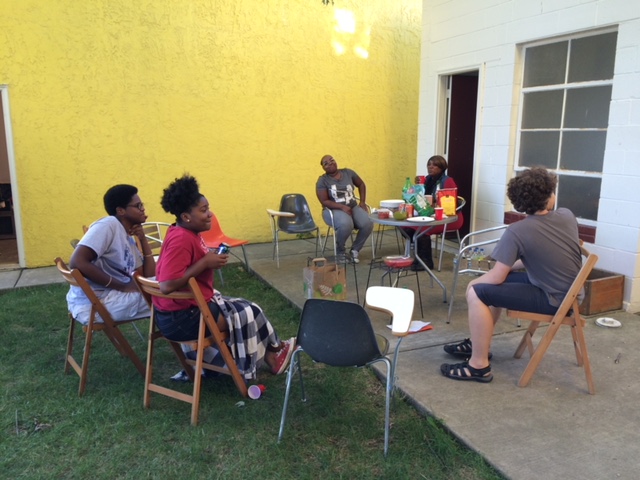
high school students meeting at Compound Yellow
By the time Compound Yellow started, my kids were already teenagers and Oak Park was all new to us. Naturally, I am more interested in older kids and their needs and what they have and don't have to meet them. We did try a camp here last year called Camp Yellow, led by Raffa Reuther and inspired by the Self-Reliance Library by Temporary Services, Brett Bloom and Marc Fischer. The library and the camp encompassed all sorts of topics: “visionary architecture, desperate or wildly imaginative mobility, miniature buildings and nomadic living, self-publishing and design, skill sharing, everyday repair solutions, running a music venue, spaces for parenthood, toys and design for children, ecologically sound living, foraging, blueprints for fantasy worlds and alternate realities, pranks and mischief, technologies used in prisons and other restrictive or impoverished settings, survivalism, weapons for self-defense or recreation, and creative approaches to living radically.” It was nice for the kids but being new to Oak Park, we decided to wait until we really knew what we were doing at CY before launching another camp scenario. Also, I now have a full time job, and my kids do not want to do camp with me or anyone else.

Alberto Aguilar painting, Compound Yellow, 2016


CR: Your current space, Compound Yellow, is on the same property as was formerly occupied by the Suburban, a domestic gallery run by Michelle Grabner and Brad Killam, but it doesn't seem like you've just picked up where they left off when they moved. How do you see your aims for your space, and your motivations for running it, as distinct from what they did with the Suburban?

Laura: This is an interesting question and one that we think about a lot. In terms of our family, each person had a different vision for this move: Andrew wanted a hermit hut, a place of his own; Sebastian never wanted to leave Hyde Park in the first place, but being a realist, and after making a few friends, he’s decided to build a chicken coop on the side yard with his dad and get on with it; Jasper wanted to find a place to be himself and new friends who accepted him. I wanted a space to cultivate a project with time, to stop moving for a while. I also wanted to share space, to create a kind of art commune, and to work collaboratively with others. We have all learned a lot since moving here. This desire for collaboration and community seemingly differentiates us from the Suburban's aims; however, what we share in common is significant.

As soon as we moved here, we were welcomed by the art community in Oak Park. I'd like to express gratitude to artist and organizer Sabina Ott, who played a special role in connecting me with Lora Lode and Matthew Nicholas through her own domestic project, Terrain Exhibitions, and the 4th of July Terrain Parade. Thus began my collaboration with Lora and Matthew on this project, Compound Yellow. We're now in the process of applying for Not-for-Profit status.


What inspired me personally about the Suburban is the concept of an “uncurated” space where artists are in complete control of what they produce and the criteria for what made for a successful show, according to Michelle Grabner, was "if the artists learned something about their own work from their relationship with the space, and the suburbs." We also don't sell work here or charge money for events or workshops. We are most interested in using the site as a place to prototype ideas, to cultivate sharing economies, participatory art, and interdisciplinary explorations. There is a generosity here that we inherited when we moved in: the prairie garden is so wonderful, the studio, the windows, the light, the tree, the sweet side yard, the little cinder-block hut. All the decisions made before we came along are greatly appreciated by us every day. In many ways we are connected to the Suburban and are supported by Michelle. I am inspired by what I see happening at  The Poor Farm and see connections to what we are doing here as well.

Attendees at a talk by Miriame Kaba in Compound Yellow (L Studio), 2017

CR: What have you learned about yourself, your family, and/or your artistic motivations through these projects?

Laura: What have I learned about myself through these projects? I’ve learned that I am a natural connector, that I love watching things grow; plants, people, kids, fires... minds. I’ve learned to be more flexible, to listen more and to know when to let others take the lead. I’m just beginning to learn how to take care of myself, to be a participant, to support others’ projects by going out and meeting people where they are at, not just inviting them to my house!

What have I learned about my family?  I’m learning to give them space and to let them gravitate to what really resonates with them. To not push them to participate in what I’m doing if they don’t want that, and they usually don’t these days, but that’s okay. I’m learning to honor their needs as those needs change, and it’s not easy. I continue to be inspired by artists like Alberto Aguilar, Christa Donner and Jorge Lucero, for example, who work with their families creatively in their practice; this is my motivation.

What have I learned about my artistic motivations through these projects? I've learned about collective creativity and intelligence. I think these kinds of intergenerational spaces help us find in others an extension of self and family, to rely on collective creativity to raise consciousness around what it means to be in a community where we all participate in raising our children together and trying to find meaning together. I guess I want to make everything an art project: the house, the yard, the street, the subway, the grocery store, work, family and relationships.

Ad Hoc Playground, a collaboration between Laura Shaeffer, Raffa Reuther, and Verónica Peña for Gallery 400, 2016

Dr. Rachel Epp Buller is a feminist printmaker book artist art historian university professor and mother of three. Her artistic, written, and curatorial work addresses these intersections, focusing on the maternal body and feminist care in contemporary art contexts. Her books include Reconciling Art and Mothering and a forthcoming volume on Inappropriate Bodies: Art, Design, and Maternity. She is a board member of the National Women's Caucus for Art and a regional coordinator of The Feminist Art Project, and currently serves as Associate Professor of Visual Arts and Design at Bethel College.




Friday, September 8, 2017

Events: Extended Practice Series


Cultural ReProducers is thrilled to join forces with Extended Practice, a new project merging professional skillsharing, exhibitions, and programming with on-site childcare for artist-mothers organized by Angela Lopez and Sara Holwerda. The event series, supported by the  Chicago Department of Cultural Affairs, picks up where CR's Childcare-supported series left off, and features on-site childcare, exhibitions and screenings of recent work by mother-artists, and professional practices events with networking lunches for participants. 

Find out more about the project at ExtendedPractice.com, and mark your calendars.

September 17th, 2017
11am-3pm

The Art of Making it Work: Reimagining Participation and Production as Artist Parents


Registration Fee $10 (includes childcare and lunch - vegan and gluten free options available)

Chicago Family Picnic
3711 N Ravenswood Ave #105, Chicago
, IL
On September 17th, artist and Cultural ReProducers organizer Christa Donner will lead an idea-generating conversation and strategy-building workshop on 'making it work' as a parent and artist. Participants will explore existing artist-led initiatives that address the challenges of artist-parenthood, and will reflect on their own experiences with balancing art-making and child-rearing. Through individual and collaborative activities, participants will identify key needs and desires of artists parents and will develop new models for creating a more sustainable artistic life in Chicago. Space is extremely limited, so reserve a spot for yourself and your kids right here.

Saturday, October 7th, 2017
Video Screening
(Time TBD)

The Nightingale Cinema

1084 N Milwaukee Avenue, Chicago, IL
Suggested Donation: $7- $10

An intergenerational screening of animated works by filmmakers and artists who are mothers. 
Bring the kids! Are you an animator and a mother?
Extended Practice is Accepting Submissions until September 16th!

Monday, October 30th, 2017
Ways We Make: Mothers of Color Nurturing and Building our Creative Communities 

Part 1: Childcare-Supported Gathering and Potluck 5:30-7pm
Experimental Station
6100 S. Blackstone Ave, Chicago, IL

The first of two interconnected events organized with artist Wisdom Baty, Ways We Make is a childcare-supported gathering of mothers who make. As children engage in supervised play and art making, mothers will connect with each other over a shared meal and guided conversation. Together, we will discuss the challenges of making while parenting, share strategies for how to carve out the space and time we need, and question traditional artist spaces. Registration is required: https://extendedpracticeprojects.wufoo.com/forms/extended-practice-ways-we-make/

Sunday, November 5th, 2017
Professional Practices Workshop by Selina Trepp + All-ages Performance by Spectralina

Experimental Station, workshop will be from 11am-2pm with a live performance from 2-3pm
6100 S Blackstone Ave, Chicago, IL

Registration fee: $10 (includes childcare and lunch - vegan and gf options available)

Artist Selina Trepp will give an artist talk and lead a discussion about how she empowers herself as a mother and artist. She will discuss her multi-disciplinary art practice, and will go into detail about how parenthood has affected her artistic production. Trepp will explain how she navigates  logistics, politics, and money in her practice, and her interactions with institutions. Following the talk, participants are invited to a networking lunch - and brainstorming session - guided by founders of Extended Practice, Sara Holwerda and Angela Lopez.

Afterwards all ages can enjoy a live performance by SPECTRALINA, the collaborative audio-visual performance project of artists, musicians and parents Dan Bitney and Selina Trepp. Working with an improvisational structure, Spectralina combines singing, percussion, electronics and real-time video processing. Together, Bitney and Trepp create an engaging image and sound relationships in their performances, in which projected animation and improvised sounds come together as visual music.

Tuesday, November 7th, 2017
Ways We Make: Mothers of Color Nurturing and Building our Creative Communities 
 

Part 2: Intergenerational Exhibition / Sharing, 5:30-7pm
Experimental Station
6100 S. Blackstone Ave, Chicago, IL

At the second of two interconnected events organized with artist Wisdom Baty, we will celebrate the creative work of mothers of color. Everyone is welcome to join us for this free, one-night exhibition and sharing: families and extended support networks of friends, fans and supporters. Mothers - and children - are invited to share and discuss their work at this informal, intergenerational event.

Coming in 2018...

Exhibition + Community-Building Events
Roman Susan Gallery

1224 W Loyola Ave, Chicago, IL
A rotating exhibition and weekly meet up featuring work by artists who are new moms. 
 

Free and open to the public. Children and families welcome.


Monday, July 18, 2016

Who Cares for Whom? Parenthood in the Creative Community

Alberto Aguilar, Rest Area (Museo Picasso Barcelona), 2011

The Atlantic magazine has just bafflingly proclaimed the arts “A Field Where Working Moms Aren’t Punished” just a few months after New York Magazine published Kim Brooks’ essay with the provocative tagline “Is Parenthood the Enemy of Creative Work?” (a subtitle that was recently amended.) While many of us would be hard pressed to describe the arts as a supportive field from which to combine family and career, we also resist the long-held belief that the two are incompatible. Parenthood can be profound and generative. It can also, let’s be honest, be incredibly complicated to pursue a creative career while raising a family. It is also difficult to maintain an artistic practice while coping with a serious health concern, caring for an aging parent, dealing with political oppression, or any of the other situations that intersect our lives as human beings who make art.  Yet some of the most powerful art ever made has come from those living in the thick of challenging experiences.

Courtney Kessel, In Balance With, 2010
Unlike other professions, artmaking often happens in the (unpaid) time between other responsibilities, which means it’s the first thing to be pushed aside when any semblance of free time disappears. But here’s where being creative comes in. Eventually, when we’re ready, we invent new systems of production, we adapt creative practices to work in short bursts instead of long hours, we call on friends and family for help. We think and read and plan for a time when we’ll have more time.

So the making, it will happen. But what to do when we find ourselves excluded from artist residencies or dropped by galleries at the mention of small children? Or more subtly, when we find vast numbers of cultural events inaccessible once we’ve created another person, or come to take care of one? Why should this isolate us so profoundly from our artistic communities?

One response to structural and social problems is to work collectively. This has led to a growing number of projects including Enemies of Good Art (UK), the Mothership Project (IR), Broodwork (USA), (m)other voices (NL), Invisible Spaces of Parenthood (UK), and Cultural ReProducers (USA), a creative platform I have run since 2012. These groups create an important solidarity and a critical mass.  But reaching out can be daunting when you’re juggling personal and professional responsibilities on a whole new level.

GOING PUBLIC AS A PARENT

Creating systems of support can also happen one artist at a time. There’s plenty we can do as individuals that adds up to better conditions for all artists. On the surface there might seem to be few models for art world success for anyone raising a child. The autonomous (male) genius working late into the night is a pervasive ideal, even as diverse collaborative and social practices flourish.  Women have often kept their personal lives undercover to be taken seriously as artists, so while many have also been mothers, you’d never know without some digging. In an increasingly professionalized art scene it might still seem inappropriate to bring up family if it’s not the focus of your work. But owning our roles as artists raising children can shift assumptions and create space for parenthood as one of many possible options. Many of these ideas focus specifically on mothers or parents in general, but it should go without saying here that similar tactics can be applied to include the voices of other groups as well.

Sonja Thomsen, Trace of Possibility (installation view with crawling participant), 2013
* Mention parenthood during an artist talk. A few brief words on the challenges of reconfiguring studio time or seeing things from a new perspective can have a profound impact, making parenthood seem possible, realistic, and visible. While it is typically less damaging to the reputations of male-identified artists, it’s still rare to hear a father discuss his role as caregiver. Parental roles are changing, and these conversations matter.

* Acknowledge the impact of raising a child when applying for residencies and funding where it’s relevant. When they’re writing proposals, the performative duo Spectralina (Selina Trepp & Dan Bitney) put it this way:

We are committed to being creative and engaged with the world while making sure that this includes our daughter. Having her in our life influences our outlook and thus also our creative output. Our art is inspired by our reality, as most art is. We see her inclusion in our creative life as a cultural and political position. It is important that what is represented in the culture industry isn’t limited to the experience of single people; or to people who can afford and want a nanny; or to men who have wives who take care of their kids in the background. Art should be at the forefront of social change, and in that capacity it should offer models which allow for artist families to be visible and supported.

* Depending on timing and temperament, bring the kids to art events usually populated exclusively by adults. This can be far more stressful than staying home or digging into the budget for a sitter, but under the right circumstances it can benefit everyone involved. If you have a friend with kids (or a friend who likes kids), see if you can take turns to share the experience with family but still connect with other adults.

Sonia Delaunay, Couverture de Berceau, 1911
courtesy of the artist and Musée d'Art Moderne
* Know your foremothers, and reference them. Sonia Delaunay’s formative work of pure abstraction was a baby quilt made for her newborn son in 1911. Lea Lublin moved a crib into the Musée d’Art Moderne de la ville de Paris to perform ‘mon Fils’ in 1968, caring for her seven-month-old son in public for the run of the exhibition. Housebound with a newborn, Candida Alvarez painted on linen napkins, a practice that still informs her vibrant work. Stories like these have been buried by years of taboo and gendered hierarchy. In her recent book Mothernism, Lise Haller Baggesen calls for a repositioning of motherhood as a place of experience and indeed expertise, a valid point from which to speak:

What I am asking for here, I guess, is for mothers to occupy spaces and conversations within art and academia, to claim a voice, many voices, to speak within and against the canon, to reflect on the complexities of mothering and motherhood within that context.

* Reschedule. Timing is a practical barrier that can be hard to understand without the experience of early parenthood. The events through which an artist builds connections to their creative community – opening receptions, lectures, performances – almost always take place in the evening, in the midst of some precarious dinner-bedtime ritual. Last year I noticed several shows at prominent galleries in my city had openings scheduled for 2pm on a Saturday instead of the usual Friday night thing. Had the stars aligned? If so it was just because the exhibiting artists asked for a time that worked better for them. For at least one, it was so that his partner and two young children could join him for the event.

* Reconfigure. Beyond scheduling, there are other ways to make art spaces accessible to participants of all ages. The Ottawa Art Gallery recently announced it will pilot free childcare at art openings this year. Plug Projects in Kansas City, MO, sets aside a quiet, informal space in back with markers and coloring books so that parents can nurse or chat while their overstimulated kids take a break from the crowded intensity of the opening. This is also the room where the cold drinks are kept, so everyone passes through at least once. It’s a simple fix that can lower everyone’s blood pressure and allow people with different needs to participate.

* Ask what you’ll be paid. The question of how to financially sustain our creative lives is an issue
that affects all artists. When an artist is invited to do a visiting artist lecture or develop a new project, they're not doing it for ‘free’ if they have to pay a childcare provider or negotiate with a family member. Setting guidelines for compensation not only helps to support one's own work, it helps set a precedent for treating other artists fairly. Be specific and ask if there’s money to help cover childcare or production costs. By asking, you’ve made that part of the equation visible. 

Many of us also work with artist-run spaces that have no budget to speak of, run by creative people who are happy to support artists in other ways. While artist fees are sometimes just not possible, some spaces can offer professional photo or video documentation, while others might have part of an apartment to house your family out of town, or give access to specialized equipment.  Being clear about what we need and how we can support each other allows us to build stronger creative community.

For sliding scale fee calculators and other great resources for artists and art spaces visit CARFAC (Canada), W.A.G.E. (USA) , and Paying Artists (UK).  

 Christa Donner, grant proposal sketch for the Cultural ReProducers Event Series, 2013


Christa Donner is a multimedia artist who investigates the human/animal body and its metaphors. She is the founder of Cultural ReProducers. This essay is published in partnership with Temporary Art Review, an international platform for contemporary art criticism that focuses on alternative spaces and critical exchange among disparate art communities.

Tuesday, February 23, 2016

Making It: Aviatrix Atelier, Berlin


Making It
profiles cultural producers creating the systems of support they need in the art community. The events, spaces, and other projects here s
upport the work of professional artists while also being accessible to families.

kids take over the child-height mezzanine gallery overlooking Aviatrix's café
Just down the street from Berlin’s  Tempelhofer Park - an expansive public part that was once the city's main airport - it might be easy to pass by the modest Aviatrix Atelier without knowing what's brewing inside. Its name invoking the adventurous spirit of female pilots, Aviatrix is a vibrant little social club, an evolving all-ages studio, gallery, and café organized by and for creative parents and their families, as well as the local community.

When designer and artist Renata
flexible workspace during the week = gallery + event space on the weekend
Faccenda first became a mother, she realized that bringing her baby into a typical shared studio cooperative just wasn’t going to work. Instead, she joined forces with other mother-artists in the city to make something new. After some early attempts at configuring child-friendly collaborative spaces with others she met Sarah Salters, a clothing designer and teacher who shared her vision for an all-ages studio with space for work, play, and public events. The duo secured a multi-room storefront space in the Neuköln neighborhood, and Aviatrix Atelier was born.

Aviatrix operates in so many ways it’s a little hard to keep track sometimes. On weekdays, its core group of parents share a dedicated studio in the back, while up front a high-ceilinged room equipped with wide tables, lamps, and wifi is rented out as co-working space. On weekends, its custom-built furniture (designed by Renata herself) folds up and away to serve as a pop-up gallery for all-ages exhibitions, film screenings, performances, and dance parties with great musicians and DJs. You enter all this through an adjacent café that doubles as a sort of social club for the creative community, featuring simple but
tasty food and drink and a small boutique selling the creative work of Aviatrix collaborators.

children emerge from the mezzanine gallery over the café during an exhibition
I felt lucky to experience the magic of this place during a solo show of my work there this fall. It felt even luckier to get to share it with my four-year-old daughter. To be sure, Aviatrix is a pretty cool place for adults to hang out, but Renata and Sarah are also deeply invested in the creativity of children: all exhibiting artists are asked to lead low-cost workshops for kids, part of the atelier's multifaceted children's studio programming. A kid-height mezzanine gallery built over the coffeeshop is the perfect space for young creatives to showcase their art for the public, curate their own exhibitions, or (between exhibitions) just contribute to the washable graffiti covering the mini-gallery’s ceiling and windows, while keeping an eye on their parents in the café below.

Berlin is a pretty special city in its approach to integrating family life into the larger culture: childcare is affordable for all, playgrounds double as sculpture parks, and there's an amazing array of “Eltern-Kind-Cafés,” relaxed coffeeshops and restaurants that include built-in sandboxes, toys, or indoor slides, and even playgrounds with adjacent beer gardens (a concept we can only fantasize about in the US).  Still, what Aviatrix offers is unique. Billed as "Berlin's only kid-friendly atelier,"  it’s not just for families, but truly supports artists of all ages. For more photos, videos, and news about events past and present, check out Aviatrix's Facebook feed and explore their website for more information.

Balloons - Tartaruga Feliz Solo Show from Tartaruga Feliz on Vimeo.

*  *  *  *  *   *  *  *  *  * *  *  *  *  * *  *  *  *  * *  *  *  *  * *  *  *  *  * *  *  *  *  *
Christa Donner reimagines the human / animal body through a range of media including large-scale drawing, printmaking, digital animation, and small-press publication. Her process often incorporates public projects and collaborations around narratives of bodily experience. Her work is exhibited internationally, including projects for the Museum Bellerive (Zurich, Switzerland); the Horst-Janssen Museum (Oldenberg, Germany); Kravets-Wehby Gallery (New York, USA); BankART NYK (Yokohama, Japan); Chiaki Kamikawa Contemporary Art (Paphos, Cyprus); the ANTI Festival of Contemporary Art (Kuopio, Finland); and the Centro Columbo Americano (Medellin, Colombia).

Friday, February 20, 2015

Parenting isn't hard. Being in a community with non-parents is: a reflection on my first year of motherhood

For many artists the hardest thing about new parenthood can be the sudden isolation from creative community that often accompanies it. On her blog, filmmaker, educator, and activist Sara Zia Ebrahimi Hughes writes honestly and provocatively on her blog about the frustration she found in navigating her own first year as a mother, and allowed us to share it here.

I’m not someone who ever dreamed of having a child. My daughter, now almost one year old, was a delightful surprise. When my partner and I discovered I was pregnant, one of our many conversations amidst the flurry of panic and excitement was about our commitment to our art practices. No matter how hard it was, we would not stop being artists. One of our main priorities, in addition to the health and wellness of our child, would be to support each other in being able to have creative time. We were determined to not to become parents whose lives only centered around their children, not as judgement against those people, but because we knew we wouldn’t be happy.

And I have to say, we did a pretty good job all things considered. He taught himself how to do VJing–live time video projection–and video projection mapping and performed several shows in 2014 at venues like the Trocadero and Underground Arts. I wrote and directed the first two episode of a high production value web series when our daughter was 6 months old, pumping on set and waking up three times a night after 15 hour days on set to breast feed. I also was on the screening committee and volunteered at the BlackStar Film Festival (where childcare for filmmakers and committee members was offered).

I was so worried that the lack of sleep, breastfeeding, enduring crying sessions and all the craziness that comes with living with an infant would be too hard for me. Don’t get me wrong, there were absolutely difficult moments. Surprisingly though, overall it wasn’t that bad. What has been devastating and unexpectedly difficult, however, has been trying to stay connected with communities I used to share with non-parent friends.

I describe my cultural background as “kebab, grits and kale.” I am an Iranian-American, raised by hippies in the U.S. south. I grew up in communities–both amidst the (mostly white) hippies and the Persians–where intergenerational connections were strong. When someone threw a party, all the kids were thrown into one room and the older kids took care of the younger ones. If anyone got hurt, you went and got an adult. I grew up with visions of adults who were whole people, fun and a little crazy. There was always space for children of all ages. I guess I (wrongly) assumed that would be my experience as a parent in arts and activism circles here in Philadelphia as well.

After having a kid in 2014, my social options were suddenly minimal. I receive dozens of invitations from friends, well intentioned and in the spirit of inclusion, and over and over again have to ask them: is there childcare at this event? Is there a space set up for kids? It’s exhausting. And, depressing.

After a year it’s finally becoming clear what’s been so difficult about my first year of motherhood: segregation from my non-parent friends.

I no longer can go to workshops on filmmaking, discussions on cultural representation, literary salons and poetry readings, board game night at a friend’s – because there is no childcare or or space for children made. I can’t pursue my interests and dreams of learning to DJ better, join a writing group, or tear up someone’s living room floor dancing–because there is no childcare or  space for children made.

I can go to mommy groups and talk about breastfeeding, poop or how tired we all are. But that doesn’t feed me. I don’t feel whole or alive in those spaces. They are segregated spaces for parents only. My vision of the world and the communities I existed in have never been monolithic in any way.

When you don’t offer childcare or make space for children, you exclude people from your community and deny them their humanness. Same as when you don’t offer accessibility options at your events. What you communicate by making these decisions is that parents and disabled people are not welcome in your community. It is particularly hurtful and problematic when that message comes from people who claim to be committed to social justice.

Before my daughter was born, I wasn’t great about inclusion myself. I admit. This isn’t finger pointing, but awareness-raising.

My commitment in 2015 is to challenge every invitation I get with the question: will there be childcare or a space for kids to play/sleep? I encourage you to make yours to figure out a way to say yes.

Wednesday, May 21, 2014

The Art of Not Leaving the House

The Day Sondra Bird Was Born, The
Cicada Sang
, performed by Vicki Fowler
photo: Ryan Bach
The day before Mother’s Day 2014 Christa and I met up on Chicago’s Southside, in the Bridgeport neighborhood, to take a guided tour of the exhibition / salon Left the House. This invitation-only event was curated and organized by Vicki Fowler, and works by twenty four artists were presented in situ amongst the furniture, toys, pets, kitchen sink and shower curtains of the home that she shares with her partner and their infant daughter.

Christina Cosio's Sticky Rice
photo: Ryan Bach
Printed materials interspersed throughout the show, such as hand written letters or photocopied zines, were available to handle and viewers were encouraged to read them aloud. These pseudo–performative moments worked in contrast to the hospitality performances featuring mixed drinks on hand-written coasters (Trevor Martin) and sticky rice cooked up from a family recipe (Christina Cosio). Similarly, one might duck into a darkened office space and listen to an intensely raw audio recording by Anne-Marie Lindquist or step out onto the back porch and participate in Rebecca Parker’s graceful laundry-folding dance using sweet smelling, just-out-of-the-dryer bedsheets.
I Leave You In Good Hands, folding warm sheets
with Rebecca Parker. photo: Ryan Bach

With apartment galleries a perpetual hot topic in the city, it’s interesting to note that Fowler’s home functioned as one, going by the name Mutherland coincidentally, from 2007-2009. Although oftentimes apartment galleries end up mimicking the white cube of commercial galleries or contemporary art spaces, there was no such pretense here. It was interesting to experience an exhibition so deeply and unapologetically enmeshed within a domestic dwelling that also featured work that depicted or engaged with issues surrounding domesticity, the role of the
Kelli Connel's My Head
Under Her Shirt
hung over
the sleeping baby's crib.
photo: Ryan Bach
caregiver, the agency of the child, and the grisly and euphoric mixture of emotions that embody parenthood.


Admittedly, some of the works on view were alienating in their specificity, while others blended so well with the pre-existing stuff of living that guides periodically leaned in to explain a piece we’d just walked by. Overall, the project’s premise was an extremely earnest one, and a profoundly intimate gesture of creative generosity. Left the House illustrated that you don’t have to miss much by being homebound if — as Fowler did — you bring the outside in.

*  *  *  *  *  *  *  *  *  *  *  *  *  *  *  *  *  *  *  *  *  *  *  *  *  *  *  *  *  *  * 

Thea Liberty Nichols is a curator and writer from Chicago.