Showing posts with label gallery. Show all posts

Monday, July 9, 2018

Interview: Laura Shaeffer

Compound Yellow Workspace, drawing by Madeline Aguilar


Laura Shaeffer
is an artist-organiser cultural producer, and informal educator based in Oak Park, Illinois since 2016. Over the past 20 years, she has worked alone and in collaboration on numerous projects housed within unconventional and often underutilized spaces on the South Side of Chicago, including Home Gallery, The Op Shop and Southside Hub of Production (SHoP) and now, in Oak Park, Compound Yellow. 


She specializes in developing collaborative networks in the arts and other creative endeavors.

"Her approach is a combination of activism and common sense; community building and home-making. She honors domestic spaces as sites of radical, informal pedagogy, and this manifests itself in an important through line that runs across her projects; they act as platforms for kids to express their creativity and imagination, and indulge their curiosity. Alongside immersing them in art and cultural production, an important byproduct of this is kids’ engagement with other kids, families, neighbors and neighborhoods. By remaining open, nurturing organic expansion and leveraging intuition, Shaeffer stewards growth rather than shoehorning artists into rigid themes or mapping them onto discrete timelines."
                                                                                           - Thea Liberty Nichols for Bad at Sports


Cultural ReProducers is thrilled to share this interview with Laura conducted by artist and art historian Rachel Epp Buller, whose recent research has led her to investigate care, correspondence, and domestic art spaces as creative practice.

*   *   *   *   *   *   *   *   *   *   *   *   *   *   *   *   *   *   *   *   *   *   *   *   *   *   *

CR: As a 'Cultural ReProducer,' what would you like to share with us about your family?

Laura Shaeffer (third from the left) and family.
Laura: My husband, Andrew, and I have two sons, Jasper now 16 and Sebastian almost 14, and a very sweet but challenging Bull Terrier, Shelby. I think most every project I’ve been involved in since becoming a new parent has been inspired by my children's surprising perspectives, needs, and honest responses to the conditions of their lives. They are both introverts like their father, extremely creative and critical people who have more or less gone along with my crazy ideas and strategies for how to work with whatever you have to create a world in which you want to live.

When I moved back to the U.S. from Berlin, where I had been living for many years, I experienced culture shock and felt very isolated, and having children initially increased that sense of isolation and feeling alienated from the art world. To address this issue, we decided to open our own home in Hyde Park as a “gallery,” a place to gather, meet other artists and get to know our neighbors.

It was at that point that I began to see my kids and other kids as collaborators: with their spontaneous and unbridled curiosity, their ridiculous gestures, and their brutal honesty, they became at times Fluxus mentors, instigators, guinea pigs and my hardest critics. I realized the more I tried to be a “good” parent and do what “good” Moms are supposed to do, the worse it was for my kids. I had to find a way, or multiple ways,  to combine creative practices with parenting, and this led to HOME, our first project together. 


Hoyun Son (stairs) and Samantha Hill (photos) at HOME, 2013


CR: You've experimented with a number of different types of alternative arts spaces. Can you tell us about the different motivations behind HOME, The Op Shop, SHoP, and Compound Yellow?

Laura: I think finding creative ways of meeting unmet needs in our neighborhoods as well developing strategies for finding collaborators and new connections between people is the common motivation behind all these projects for me. Also, I love art experienced in unconventional places.

 The first project space we opened in 2000 was in a dilapidated old department store above the Arc Thrift Store; we called it CAN Gallery. For one year we invited local artists (mostly young students) to exhibit and interspersed these local shows with exhibitions of Berlin-based artists. The motivation here was to ease the culture shock of moving back to the U.S. after 13 years in Europe and to find new connections with artists in Chicago.

The second project, HOME, we started 3 years after moving to Hyde Park and after having two small boys. The motivation was to build a creative community where you live. I invited all of my neighbors, kids, families, older people and artists from all over Chicago and beyond. We ran HOME for 7 years and had at least 12 exhibitions. Through this experiment we met so many people living in Hyde Park and so many artists living all over Chicago. In this sense it was a very fulfilling experience.

In 2009 Hyde Park was riddled with empty storefronts; I wondered why there were no independent galleries or independent cultural projects here so I decided to find a public space to make one. I approached Mac Realty with an offer to clean up and care for an empty space for one month for $1, returning it in better condition when I left. This was the start of a series of experimental cultural projects that moved all over Hyde Park. The Op Shop had a sense of freedom and fluidity: each Op Shop had a strategy or theme, and for most of these I worked in partnership with a different artist. It became a way to informally research the neighborhood of Hyde Park and the broader South Side.

 Soft Shop, a participatory installation by Chris Lin and Kayce Bayer at SHoP, 2012

Op Shop opened the door and paved the way to a bigger and more ambitious project that developed with the opportunity of renting a 16-room mansion, the Fenn House, near the University of Chicago campus. In 2010, SHoP (Southside Hub of Production), was conceived by a small group of forward thinkers and artists including John Preus, Eric Peterson, Mike Phillips, and myself as a place to stimulate local cultural activity, provide spaces for artists and neighbors to work, perform, exhibit, collaborate and socialize, and for relevant community programming.

SHoP became a vital cultural and social hub for all ages. For the 15 months of its existence, SHoP continued to enjoy that fluid, flexible and organic quality of the Op Shop but the question of sustainability loomed over us as Hyde Park became more and more gentrified. Fenn House was put up for sale in 2014.


Sebastian, Jasper, & Andrew at HOME w. work by Shawn Greene and Katrin Asbury 
 CR: How did your children react to living with art in their home and to having their home double as a gallery space for the public (at least periodically)?

Laura: I think they had mixed feelings about all of it. Their views and memories change over the years. On any given day, they may say something like: "I don't know, it was fun I guess," or  "No, I loved it, it was cool being around all of those artists and doing crazy things," to other less favorable responses that I have had to pay attention to, like "I just want to have some privacy and I don't care about art or any of this!"


CR: I read that part of your vision for SHoP was to offer an after-school space for kids - a kind of community maker-space. Can you tell us more about that, and how it worked? And does that element, of serving younger audiences as well as adults, continue in Compound Yellow?

HOME SCHOOL kids visit Dibs Garden, by Curtis Myers
Laura: We set up a space in the Fenn House that we called the Autonomous Making Space.
collected donations of all kinds of materials and bought tools for the kids to use to make things out of wood and other stuff. We tried to set it up for families and latchkey kids to come in and work anytime we were open and put things back in their places to keep a sense of communal order. (That order part didn't work out terribly well, which became the impetus for a wonderful project by Jorge Lucero, educational prompts and placards for the Autonomous Studio).

Coming from a long line of teachers, I vowed that I would never become one myself. However, my
mother, a devout educator for over 50 years, inspired a love of and passion for education in me that is behind all that I do. She brought me to conferences with her on topics of multiple intelligences, alternative pedagogy and radical philosophies of education as a young child.  I used to volunteer in my son's classroom on Fridays, bringing unusual materials in for the kids to work with; they didn’t have art in school then. They loved making their own new worlds from straws, clay and broom bristles, for example. The results were unimaginable and wonderful. Later when the kids got a little older, I started an after school program that ran from 2011 to 2015. We used an empty apartment and called it HOME SCHOOL #3, part of much larger project with other iterations and locations. We also used the basement of the Quaker House for some time. The idea was to fill the spaces with donated materials and allow the kids to freely engage with them in an open and creative environment. The adults (artists, actors, writers, filmmakers) acted as facilitators and collaborators, allowing themselves to be led by the desires and ideas of the children. It was an awesomely inspiring time for us all. I also co-ran summer camps with artists like Matthew Searle, Jerry Marciniak, Spencer Hutchinson, Hoyun Son, Dan Godston, Nitsana Lazerus and so many more for years in Hyde Park. We had kids ranging from 3 to 13, a very diverse group; many of the same kids came every summer. It was a wild and memorable ride, and one of the most significant projects in terms of mothering as an artist. My own kids of course took part in these camps, which was also a way to be with them and provide for them when school was out.
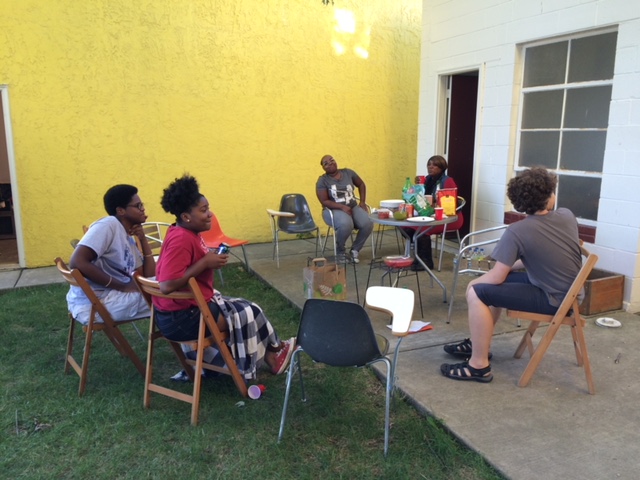
high school students meeting at Compound Yellow
By the time Compound Yellow started, my kids were already teenagers and Oak Park was all new to us. Naturally, I am more interested in older kids and their needs and what they have and don't have to meet them. We did try a camp here last year called Camp Yellow, led by Raffa Reuther and inspired by the Self-Reliance Library by Temporary Services, Brett Bloom and Marc Fischer. The library and the camp encompassed all sorts of topics: “visionary architecture, desperate or wildly imaginative mobility, miniature buildings and nomadic living, self-publishing and design, skill sharing, everyday repair solutions, running a music venue, spaces for parenthood, toys and design for children, ecologically sound living, foraging, blueprints for fantasy worlds and alternate realities, pranks and mischief, technologies used in prisons and other restrictive or impoverished settings, survivalism, weapons for self-defense or recreation, and creative approaches to living radically.” It was nice for the kids but being new to Oak Park, we decided to wait until we really knew what we were doing at CY before launching another camp scenario. Also, I now have a full time job, and my kids do not want to do camp with me or anyone else.

Alberto Aguilar painting, Compound Yellow, 2016


CR: Your current space, Compound Yellow, is on the same property as was formerly occupied by the Suburban, a domestic gallery run by Michelle Grabner and Brad Killam, but it doesn't seem like you've just picked up where they left off when they moved. How do you see your aims for your space, and your motivations for running it, as distinct from what they did with the Suburban?

Laura: This is an interesting question and one that we think about a lot. In terms of our family, each person had a different vision for this move: Andrew wanted a hermit hut, a place of his own; Sebastian never wanted to leave Hyde Park in the first place, but being a realist, and after making a few friends, he’s decided to build a chicken coop on the side yard with his dad and get on with it; Jasper wanted to find a place to be himself and new friends who accepted him. I wanted a space to cultivate a project with time, to stop moving for a while. I also wanted to share space, to create a kind of art commune, and to work collaboratively with others. We have all learned a lot since moving here. This desire for collaboration and community seemingly differentiates us from the Suburban's aims; however, what we share in common is significant.

As soon as we moved here, we were welcomed by the art community in Oak Park. I'd like to express gratitude to artist and organizer Sabina Ott, who played a special role in connecting me with Lora Lode and Matthew Nicholas through her own domestic project, Terrain Exhibitions, and the 4th of July Terrain Parade. Thus began my collaboration with Lora and Matthew on this project, Compound Yellow. We're now in the process of applying for Not-for-Profit status.


What inspired me personally about the Suburban is the concept of an “uncurated” space where artists are in complete control of what they produce and the criteria for what made for a successful show, according to Michelle Grabner, was "if the artists learned something about their own work from their relationship with the space, and the suburbs." We also don't sell work here or charge money for events or workshops. We are most interested in using the site as a place to prototype ideas, to cultivate sharing economies, participatory art, and interdisciplinary explorations. There is a generosity here that we inherited when we moved in: the prairie garden is so wonderful, the studio, the windows, the light, the tree, the sweet side yard, the little cinder-block hut. All the decisions made before we came along are greatly appreciated by us every day. In many ways we are connected to the Suburban and are supported by Michelle. I am inspired by what I see happening at  The Poor Farm and see connections to what we are doing here as well.

Attendees at a talk by Miriame Kaba in Compound Yellow (L Studio), 2017

CR: What have you learned about yourself, your family, and/or your artistic motivations through these projects?

Laura: What have I learned about myself through these projects? I’ve learned that I am a natural connector, that I love watching things grow; plants, people, kids, fires... minds. I’ve learned to be more flexible, to listen more and to know when to let others take the lead. I’m just beginning to learn how to take care of myself, to be a participant, to support others’ projects by going out and meeting people where they are at, not just inviting them to my house!

What have I learned about my family?  I’m learning to give them space and to let them gravitate to what really resonates with them. To not push them to participate in what I’m doing if they don’t want that, and they usually don’t these days, but that’s okay. I’m learning to honor their needs as those needs change, and it’s not easy. I continue to be inspired by artists like Alberto Aguilar, Christa Donner and Jorge Lucero, for example, who work with their families creatively in their practice; this is my motivation.

What have I learned about my artistic motivations through these projects? I've learned about collective creativity and intelligence. I think these kinds of intergenerational spaces help us find in others an extension of self and family, to rely on collective creativity to raise consciousness around what it means to be in a community where we all participate in raising our children together and trying to find meaning together. I guess I want to make everything an art project: the house, the yard, the street, the subway, the grocery store, work, family and relationships.

Ad Hoc Playground, a collaboration between Laura Shaeffer, Raffa Reuther, and Verónica Peña for Gallery 400, 2016

Dr. Rachel Epp Buller is a feminist printmaker book artist art historian university professor and mother of three. Her artistic, written, and curatorial work addresses these intersections, focusing on the maternal body and feminist care in contemporary art contexts. Her books include Reconciling Art and Mothering and a forthcoming volume on Inappropriate Bodies: Art, Design, and Maternity. She is a board member of the National Women's Caucus for Art and a regional coordinator of The Feminist Art Project, and currently serves as Associate Professor of Visual Arts and Design at Bethel College.


Tuesday, June 28, 2016

Making It: The Hown's Den

This summer we're pleased to partner with Temporary Art Review to share the work of cultural workers raising kids with a broader audience. Temporary Art Review is an international platform for contemporary art criticism that focuses on alternative spaces and critical exchange among disparate art communities. They're profiling projects that support the work of artist-parents, and we suggested the Hown's Den, a nomadic and domestic exhibition space where artists are invited to transform the living spaces of its three inhabitants:

Amy Kligman, "Interruptions"


The Hown's Den
Current Address: 63 Meade St. Buckhannon, WV 26201
Contact: Crystal Ann Brown
Email: crystal@thehownsden.com
Website: www.thehownsden.com
Open Hours: by appointment or at a scheduled event

How is the project operated?
 The Hown’s Den is not officially a non-profit but we would like to be some day.

How long has it been in existence? 
Almost 3 years, our fist official show was January 23, 2014.

What was your motivation?
 I wanted to experiment with an art environment that was family friendly and non-exclusive and to play around with a non-traditional art venue. At the time my family had just relocated from Athens, Ohio to Kansas City, Kansas. My partner and I were fresh out of graduate school and I was at home most of the time with our then 1-year-old while my partner worked. Faced with this new community and my role as a stay-at-home caregiver I craved inclusion into our new art scene and thought what better way to get involved in the community than to invite artists and people into our home for an art experiment. Now we have been happily experimenting in Kansas, Missouri, and West Virginia ever since.

Caitlin Horsman, "_Place_Plateau"
Number of organizers/responsible persons of the project: 1-3. I usually promote and organize on my own with the occasional help from my partner, but I am always working with the artist(s) installing their work depending on their individual needs.

How are programs funded? 
In the past we have had fundraisers like silent auctions to help fund the travel of artists coming to install work, but we are still working out other avenues of funding for the project as a whole. Currently, we are unable to pay artists for their involvement, but I hope to change that in the future.

Who is responsible for the programming? 
Myself (Crystal Ann Brown) and the artists(s) involved.

Number and average duration of exhibitions/events per year.
In the past there has been one exhibition every few months, however in our current location we are limited in what we can have installed in the space, so we have started a miniature installation project titled *not to scale that will exhibit multiple shows/installations seasonally.

What kind of events are usually organized?
 We mainly host art exhibitions, but we have hosted a backyard film festival and artist talks. We are currently looking at experimenting with lectures and presentations that compliment the miniature series *not to scale, and we are always open to proposals for other events from artists.

How is your programming determined?
 We move pretty organically, I try to gauge what my family can handle considering we live with the work and then coordinate programing from there.

Do you accept proposals/submissions?
 We do not have an official application process but I will look at proposals sent to the email addresses listed above.

Casey Whittier, "Translations and the Memory of Things"
What is your artistic/curatorial approach?
 I try to work with artists that are willing to experiment with a nontraditional art venue, while keeping in mind that the artwork will live with us and be regularly exposed to young children. I look for work that engages domestic architecture and invites imagination.

What’s working? What’s not working? 
I have found that having events on Saturdays between 11-3 works the best for families including my family. This is important because we aim to be more family friendly. I did not always do that and even now it’s hard to hold openings during that time because other art events like art walks are held in the evenings usually on a Thursday or Friday evening, which we try to piggyback on to increase audience turnout.

Having the artist(s) here for the opening has always worked well, the atmosphere allows for a more casual and honest dialogue between the artist and audience.

Creating an environment where the artwork is more integrated into the domestic setting allows for a more intimate reaction or response to the work, which is always a good thing.

In the past, artist presentations, lectures, and film screenings have not worked as well in comparison to art exhibitions, which I attribute to my focus being torn between the needs of my child and that of the presenter or film. That being said, I am interested in trying to have an in-house babysitter for nights when we will have presentations and screenings.

Cory Imig, "Linear Spaces"
What kind of role do you hope to play in your local art scene or community? 
We move around a lot because of our career paths and due to that it seems that we are moving from one community to the next. Within each community I try to engage the neighborhood that we live in. I invite neighbors to events and try to encourage people to look at art in an environment that might be outside of their comfort zone. We are use to looking at work in institutions, but being invited into the intimate space of a stranger’s home can be uncomfortable for some. It is important for us to offer an alternative space to engage in and respond to art. I also hope to perpetuate family inclusivity in the arts by engaging the domestic space as a place to look at and discuss art.

What idea are you most excited about for the future?
 I’m really looking forward to the miniature installation series *not to scale. This series was created out of not knowing how to continue on with The Hown’s Den once we moved to our current location in Buckhannon, West Virginia. We are renting and are very limited in what we can and can’t do to the interior of the home so as a solution I am building miniature mockups of rooms in our home, that I then mail out to the artist. Once the artist receives the miniature they are free to do whatever they want with the room. There are limitless possibilities for installation. Once the work is complete the artist will send the miniature back and we will hang it from the ceiling in the room it was intended to be a miniature of. We will host an opening at The Hown’s Den for our local community, but will also have a digital opening for more intimate photos of the miniatures. I am currently pairing up 2-3 artists to exhibit their miniatures at the same time, because I love the idea of bringing artists together and seeing the dialogue between art works unfold.

Dawlene-Jane Oni-Eseleh, "Inside Voices"

Friday, July 4, 2014

Interview: Chiaki Kamikawa

Chiaki Kamikawa is an artist and gallerist based in Paphos, Cyprus. We met as artists-in-residence at BankArt NYK in Yokohama, Japan before either of us were mothers, where I was lucky to see the wild energy of her drawings, sculptures and small-press zines develop firsthand. Chiaki's work is exhibited widely throughout Europe and Japan. She also runs Chiaki Kamikawa Contemporary Art, a gallery showcasing local and international work as well as art workshops, cultural events, and her own working studio. You can catch some of her latest work in the exhibition The Intuitionists, opening at The Drawing Center in New York on July 11th, 2014.

CR: First, briefly describe your daughter in your own words.


Chiaki: My daughter Savvena Sayuri is 11 months old. She is very active and social.  She loves nature and wildlife.

CR: What’s the art community like in Paphos? How did you get started running a gallery and building an audience there?

Chiaki: The art community in Paphos is quite big and international for the size of the town. I think the relationship between artists is much closer than in a larger city: we get to know each other’s families, where we live, each others' interests, etc.  What I really like about our art community is that there is a family-like atmosphere and interaction between different age groups.


In 2011 when I was looking for a place for my studio, I came across with a space that, I thought, would be a perfect place for a gallery. I wasn't thinking of starting one, but as I thought it over it seemed more logical to open a studio/gallery myself in Paphos. At that time there wasn't any contemporary gallery that organized its own exhibitions. At the beginning I gathered local artists, and gradually I met more artists whose work I wanted to show. To build up a diverse audience, I try to organize exhibitions with local Cypriot artists as well as international artists. Especially in a place like Paphos, I think it is important to introduce artists’ work from abroad so that the local audience can see work beyond what is already familiar.

CR:  What is it like to be a working artist-mother in Cyprus versus in your native Japan?


Chiaki: Women are encouraged to work after having a child in Cyprus, therefore there are a lot of working mothers. Traditionally grandparents look after their grandchildren while parents are working, and this tradition continues until today.  
In my case, my mother-in-law takes care of my daughter while I am working and other family members are also supporting me a lot. The family bond is very strong in Cyprus, and for working mothers this bond
means a huge help. 

In Japan, especially in the big city where I was raised, working mothers have to find another way to raise their children. Many people don't live near grandparents and children usually go to public/private childcare while mothers are working.  Good childcare is not always available and some mothers have to stop working and wait before they can start it again.

To be honest, I don’t know if it would have been possible for me to be an artist and run a gallery with my daughter in such a relaxed way if we were living in Japan!

CR: How do you find a balance between artmaking and parenting, running the gallery and earning an income? 

Chiaki: It is a real challenge to find a balance between everything I want to do. At the moment I consider myself as a full-time mother and part-time everything else.  My first priority is my family, and the second priority changes according to the situation.

 Basically I don’t have enough time to do everything as much as I want.  The amount of time I can spend for creative work dropped dramatically after the birth of my daughter but I am happy to continue what I want to do within my capability. I think it’s unnecessary to worry about finding a good balance between everything because I believe that the time will come back to me in near future.

CR: Thinking as big or small as you like, what kinds of things would make the international art world more accessible to artists with families?

Chiaki:
I think creating more family residency opportunities and funding for artists with families are things that can be done by both public and private institutions.

As for galleries, there are people who are now interested in collecting art for their children, and this may be a new direction for galleries to focus on besides the regular collectors.

Wednesday, May 21, 2014

The Art of Not Leaving the House

The Day Sondra Bird Was Born, The
Cicada Sang
, performed by Vicki Fowler
photo: Ryan Bach
The day before Mother’s Day 2014 Christa and I met up on Chicago’s Southside, in the Bridgeport neighborhood, to take a guided tour of the exhibition / salon Left the House. This invitation-only event was curated and organized by Vicki Fowler, and works by twenty four artists were presented in situ amongst the furniture, toys, pets, kitchen sink and shower curtains of the home that she shares with her partner and their infant daughter.

Christina Cosio's Sticky Rice
photo: Ryan Bach
Printed materials interspersed throughout the show, such as hand written letters or photocopied zines, were available to handle and viewers were encouraged to read them aloud. These pseudo–performative moments worked in contrast to the hospitality performances featuring mixed drinks on hand-written coasters (Trevor Martin) and sticky rice cooked up from a family recipe (Christina Cosio). Similarly, one might duck into a darkened office space and listen to an intensely raw audio recording by Anne-Marie Lindquist or step out onto the back porch and participate in Rebecca Parker’s graceful laundry-folding dance using sweet smelling, just-out-of-the-dryer bedsheets.
I Leave You In Good Hands, folding warm sheets
with Rebecca Parker. photo: Ryan Bach

With apartment galleries a perpetual hot topic in the city, it’s interesting to note that Fowler’s home functioned as one, going by the name Mutherland coincidentally, from 2007-2009. Although oftentimes apartment galleries end up mimicking the white cube of commercial galleries or contemporary art spaces, there was no such pretense here. It was interesting to experience an exhibition so deeply and unapologetically enmeshed within a domestic dwelling that also featured work that depicted or engaged with issues surrounding domesticity, the role of the
Kelli Connel's My Head
Under Her Shirt
hung over
the sleeping baby's crib.
photo: Ryan Bach
caregiver, the agency of the child, and the grisly and euphoric mixture of emotions that embody parenthood.


Admittedly, some of the works on view were alienating in their specificity, while others blended so well with the pre-existing stuff of living that guides periodically leaned in to explain a piece we’d just walked by. Overall, the project’s premise was an extremely earnest one, and a profoundly intimate gesture of creative generosity. Left the House illustrated that you don’t have to miss much by being homebound if — as Fowler did — you bring the outside in.

*  *  *  *  *  *  *  *  *  *  *  *  *  *  *  *  *  *  *  *  *  *  *  *  *  *  *  *  *  *  * 

Thea Liberty Nichols is a curator and writer from Chicago.