Showing posts with label family life. Show all posts

Monday, July 9, 2018

Interview: Laura Shaeffer

Compound Yellow Workspace, drawing by Madeline Aguilar


Laura Shaeffer
is an artist-organiser cultural producer, and informal educator based in Oak Park, Illinois since 2016. Over the past 20 years, she has worked alone and in collaboration on numerous projects housed within unconventional and often underutilized spaces on the South Side of Chicago, including Home Gallery, The Op Shop and Southside Hub of Production (SHoP) and now, in Oak Park, Compound Yellow. 


She specializes in developing collaborative networks in the arts and other creative endeavors.

"Her approach is a combination of activism and common sense; community building and home-making. She honors domestic spaces as sites of radical, informal pedagogy, and this manifests itself in an important through line that runs across her projects; they act as platforms for kids to express their creativity and imagination, and indulge their curiosity. Alongside immersing them in art and cultural production, an important byproduct of this is kids’ engagement with other kids, families, neighbors and neighborhoods. By remaining open, nurturing organic expansion and leveraging intuition, Shaeffer stewards growth rather than shoehorning artists into rigid themes or mapping them onto discrete timelines."
                                                                                           - Thea Liberty Nichols for Bad at Sports


Cultural ReProducers is thrilled to share this interview with Laura conducted by artist and art historian Rachel Epp Buller, whose recent research has led her to investigate care, correspondence, and domestic art spaces as creative practice.

*   *   *   *   *   *   *   *   *   *   *   *   *   *   *   *   *   *   *   *   *   *   *   *   *   *   *

CR: As a 'Cultural ReProducer,' what would you like to share with us about your family?

Laura Shaeffer (third from the left) and family.
Laura: My husband, Andrew, and I have two sons, Jasper now 16 and Sebastian almost 14, and a very sweet but challenging Bull Terrier, Shelby. I think most every project I’ve been involved in since becoming a new parent has been inspired by my children's surprising perspectives, needs, and honest responses to the conditions of their lives. They are both introverts like their father, extremely creative and critical people who have more or less gone along with my crazy ideas and strategies for how to work with whatever you have to create a world in which you want to live.

When I moved back to the U.S. from Berlin, where I had been living for many years, I experienced culture shock and felt very isolated, and having children initially increased that sense of isolation and feeling alienated from the art world. To address this issue, we decided to open our own home in Hyde Park as a “gallery,” a place to gather, meet other artists and get to know our neighbors.

It was at that point that I began to see my kids and other kids as collaborators: with their spontaneous and unbridled curiosity, their ridiculous gestures, and their brutal honesty, they became at times Fluxus mentors, instigators, guinea pigs and my hardest critics. I realized the more I tried to be a “good” parent and do what “good” Moms are supposed to do, the worse it was for my kids. I had to find a way, or multiple ways,  to combine creative practices with parenting, and this led to HOME, our first project together. 


Hoyun Son (stairs) and Samantha Hill (photos) at HOME, 2013


CR: You've experimented with a number of different types of alternative arts spaces. Can you tell us about the different motivations behind HOME, The Op Shop, SHoP, and Compound Yellow?

Laura: I think finding creative ways of meeting unmet needs in our neighborhoods as well developing strategies for finding collaborators and new connections between people is the common motivation behind all these projects for me. Also, I love art experienced in unconventional places.

 The first project space we opened in 2000 was in a dilapidated old department store above the Arc Thrift Store; we called it CAN Gallery. For one year we invited local artists (mostly young students) to exhibit and interspersed these local shows with exhibitions of Berlin-based artists. The motivation here was to ease the culture shock of moving back to the U.S. after 13 years in Europe and to find new connections with artists in Chicago.

The second project, HOME, we started 3 years after moving to Hyde Park and after having two small boys. The motivation was to build a creative community where you live. I invited all of my neighbors, kids, families, older people and artists from all over Chicago and beyond. We ran HOME for 7 years and had at least 12 exhibitions. Through this experiment we met so many people living in Hyde Park and so many artists living all over Chicago. In this sense it was a very fulfilling experience.

In 2009 Hyde Park was riddled with empty storefronts; I wondered why there were no independent galleries or independent cultural projects here so I decided to find a public space to make one. I approached Mac Realty with an offer to clean up and care for an empty space for one month for $1, returning it in better condition when I left. This was the start of a series of experimental cultural projects that moved all over Hyde Park. The Op Shop had a sense of freedom and fluidity: each Op Shop had a strategy or theme, and for most of these I worked in partnership with a different artist. It became a way to informally research the neighborhood of Hyde Park and the broader South Side.

 Soft Shop, a participatory installation by Chris Lin and Kayce Bayer at SHoP, 2012

Op Shop opened the door and paved the way to a bigger and more ambitious project that developed with the opportunity of renting a 16-room mansion, the Fenn House, near the University of Chicago campus. In 2010, SHoP (Southside Hub of Production), was conceived by a small group of forward thinkers and artists including John Preus, Eric Peterson, Mike Phillips, and myself as a place to stimulate local cultural activity, provide spaces for artists and neighbors to work, perform, exhibit, collaborate and socialize, and for relevant community programming.

SHoP became a vital cultural and social hub for all ages. For the 15 months of its existence, SHoP continued to enjoy that fluid, flexible and organic quality of the Op Shop but the question of sustainability loomed over us as Hyde Park became more and more gentrified. Fenn House was put up for sale in 2014.


Sebastian, Jasper, & Andrew at HOME w. work by Shawn Greene and Katrin Asbury 
 CR: How did your children react to living with art in their home and to having their home double as a gallery space for the public (at least periodically)?

Laura: I think they had mixed feelings about all of it. Their views and memories change over the years. On any given day, they may say something like: "I don't know, it was fun I guess," or  "No, I loved it, it was cool being around all of those artists and doing crazy things," to other less favorable responses that I have had to pay attention to, like "I just want to have some privacy and I don't care about art or any of this!"


CR: I read that part of your vision for SHoP was to offer an after-school space for kids - a kind of community maker-space. Can you tell us more about that, and how it worked? And does that element, of serving younger audiences as well as adults, continue in Compound Yellow?

HOME SCHOOL kids visit Dibs Garden, by Curtis Myers
Laura: We set up a space in the Fenn House that we called the Autonomous Making Space.
collected donations of all kinds of materials and bought tools for the kids to use to make things out of wood and other stuff. We tried to set it up for families and latchkey kids to come in and work anytime we were open and put things back in their places to keep a sense of communal order. (That order part didn't work out terribly well, which became the impetus for a wonderful project by Jorge Lucero, educational prompts and placards for the Autonomous Studio).

Coming from a long line of teachers, I vowed that I would never become one myself. However, my
mother, a devout educator for over 50 years, inspired a love of and passion for education in me that is behind all that I do. She brought me to conferences with her on topics of multiple intelligences, alternative pedagogy and radical philosophies of education as a young child.  I used to volunteer in my son's classroom on Fridays, bringing unusual materials in for the kids to work with; they didn’t have art in school then. They loved making their own new worlds from straws, clay and broom bristles, for example. The results were unimaginable and wonderful. Later when the kids got a little older, I started an after school program that ran from 2011 to 2015. We used an empty apartment and called it HOME SCHOOL #3, part of much larger project with other iterations and locations. We also used the basement of the Quaker House for some time. The idea was to fill the spaces with donated materials and allow the kids to freely engage with them in an open and creative environment. The adults (artists, actors, writers, filmmakers) acted as facilitators and collaborators, allowing themselves to be led by the desires and ideas of the children. It was an awesomely inspiring time for us all. I also co-ran summer camps with artists like Matthew Searle, Jerry Marciniak, Spencer Hutchinson, Hoyun Son, Dan Godston, Nitsana Lazerus and so many more for years in Hyde Park. We had kids ranging from 3 to 13, a very diverse group; many of the same kids came every summer. It was a wild and memorable ride, and one of the most significant projects in terms of mothering as an artist. My own kids of course took part in these camps, which was also a way to be with them and provide for them when school was out.
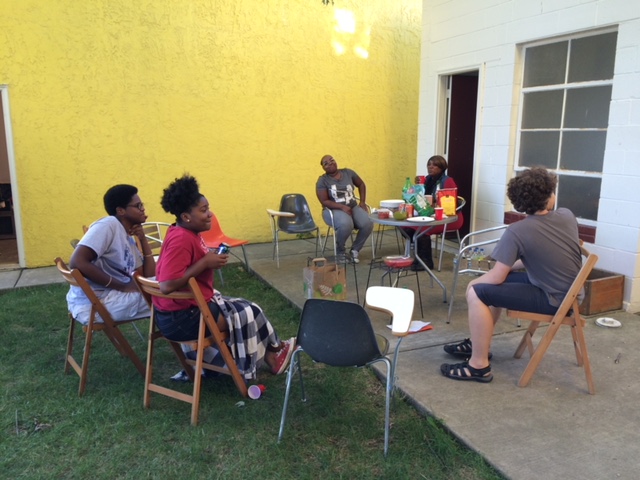
high school students meeting at Compound Yellow
By the time Compound Yellow started, my kids were already teenagers and Oak Park was all new to us. Naturally, I am more interested in older kids and their needs and what they have and don't have to meet them. We did try a camp here last year called Camp Yellow, led by Raffa Reuther and inspired by the Self-Reliance Library by Temporary Services, Brett Bloom and Marc Fischer. The library and the camp encompassed all sorts of topics: “visionary architecture, desperate or wildly imaginative mobility, miniature buildings and nomadic living, self-publishing and design, skill sharing, everyday repair solutions, running a music venue, spaces for parenthood, toys and design for children, ecologically sound living, foraging, blueprints for fantasy worlds and alternate realities, pranks and mischief, technologies used in prisons and other restrictive or impoverished settings, survivalism, weapons for self-defense or recreation, and creative approaches to living radically.” It was nice for the kids but being new to Oak Park, we decided to wait until we really knew what we were doing at CY before launching another camp scenario. Also, I now have a full time job, and my kids do not want to do camp with me or anyone else.

Alberto Aguilar painting, Compound Yellow, 2016


CR: Your current space, Compound Yellow, is on the same property as was formerly occupied by the Suburban, a domestic gallery run by Michelle Grabner and Brad Killam, but it doesn't seem like you've just picked up where they left off when they moved. How do you see your aims for your space, and your motivations for running it, as distinct from what they did with the Suburban?

Laura: This is an interesting question and one that we think about a lot. In terms of our family, each person had a different vision for this move: Andrew wanted a hermit hut, a place of his own; Sebastian never wanted to leave Hyde Park in the first place, but being a realist, and after making a few friends, he’s decided to build a chicken coop on the side yard with his dad and get on with it; Jasper wanted to find a place to be himself and new friends who accepted him. I wanted a space to cultivate a project with time, to stop moving for a while. I also wanted to share space, to create a kind of art commune, and to work collaboratively with others. We have all learned a lot since moving here. This desire for collaboration and community seemingly differentiates us from the Suburban's aims; however, what we share in common is significant.

As soon as we moved here, we were welcomed by the art community in Oak Park. I'd like to express gratitude to artist and organizer Sabina Ott, who played a special role in connecting me with Lora Lode and Matthew Nicholas through her own domestic project, Terrain Exhibitions, and the 4th of July Terrain Parade. Thus began my collaboration with Lora and Matthew on this project, Compound Yellow. We're now in the process of applying for Not-for-Profit status.


What inspired me personally about the Suburban is the concept of an “uncurated” space where artists are in complete control of what they produce and the criteria for what made for a successful show, according to Michelle Grabner, was "if the artists learned something about their own work from their relationship with the space, and the suburbs." We also don't sell work here or charge money for events or workshops. We are most interested in using the site as a place to prototype ideas, to cultivate sharing economies, participatory art, and interdisciplinary explorations. There is a generosity here that we inherited when we moved in: the prairie garden is so wonderful, the studio, the windows, the light, the tree, the sweet side yard, the little cinder-block hut. All the decisions made before we came along are greatly appreciated by us every day. In many ways we are connected to the Suburban and are supported by Michelle. I am inspired by what I see happening at  The Poor Farm and see connections to what we are doing here as well.

Attendees at a talk by Miriame Kaba in Compound Yellow (L Studio), 2017

CR: What have you learned about yourself, your family, and/or your artistic motivations through these projects?

Laura: What have I learned about myself through these projects? I’ve learned that I am a natural connector, that I love watching things grow; plants, people, kids, fires... minds. I’ve learned to be more flexible, to listen more and to know when to let others take the lead. I’m just beginning to learn how to take care of myself, to be a participant, to support others’ projects by going out and meeting people where they are at, not just inviting them to my house!

What have I learned about my family?  I’m learning to give them space and to let them gravitate to what really resonates with them. To not push them to participate in what I’m doing if they don’t want that, and they usually don’t these days, but that’s okay. I’m learning to honor their needs as those needs change, and it’s not easy. I continue to be inspired by artists like Alberto Aguilar, Christa Donner and Jorge Lucero, for example, who work with their families creatively in their practice; this is my motivation.

What have I learned about my artistic motivations through these projects? I've learned about collective creativity and intelligence. I think these kinds of intergenerational spaces help us find in others an extension of self and family, to rely on collective creativity to raise consciousness around what it means to be in a community where we all participate in raising our children together and trying to find meaning together. I guess I want to make everything an art project: the house, the yard, the street, the subway, the grocery store, work, family and relationships.

Ad Hoc Playground, a collaboration between Laura Shaeffer, Raffa Reuther, and Verónica Peña for Gallery 400, 2016

Dr. Rachel Epp Buller is a feminist printmaker book artist art historian university professor and mother of three. Her artistic, written, and curatorial work addresses these intersections, focusing on the maternal body and feminist care in contemporary art contexts. Her books include Reconciling Art and Mothering and a forthcoming volume on Inappropriate Bodies: Art, Design, and Maternity. She is a board member of the National Women's Caucus for Art and a regional coordinator of The Feminist Art Project, and currently serves as Associate Professor of Visual Arts and Design at Bethel College.


Tuesday, June 28, 2016

Making It: The Hown's Den

This summer we're pleased to partner with Temporary Art Review to share the work of cultural workers raising kids with a broader audience. Temporary Art Review is an international platform for contemporary art criticism that focuses on alternative spaces and critical exchange among disparate art communities. They're profiling projects that support the work of artist-parents, and we suggested the Hown's Den, a nomadic and domestic exhibition space where artists are invited to transform the living spaces of its three inhabitants:

Amy Kligman, "Interruptions"


The Hown's Den
Current Address: 63 Meade St. Buckhannon, WV 26201
Contact: Crystal Ann Brown
Email: crystal@thehownsden.com
Website: www.thehownsden.com
Open Hours: by appointment or at a scheduled event

How is the project operated?
 The Hown’s Den is not officially a non-profit but we would like to be some day.

How long has it been in existence? 
Almost 3 years, our fist official show was January 23, 2014.

What was your motivation?
 I wanted to experiment with an art environment that was family friendly and non-exclusive and to play around with a non-traditional art venue. At the time my family had just relocated from Athens, Ohio to Kansas City, Kansas. My partner and I were fresh out of graduate school and I was at home most of the time with our then 1-year-old while my partner worked. Faced with this new community and my role as a stay-at-home caregiver I craved inclusion into our new art scene and thought what better way to get involved in the community than to invite artists and people into our home for an art experiment. Now we have been happily experimenting in Kansas, Missouri, and West Virginia ever since.

Caitlin Horsman, "_Place_Plateau"
Number of organizers/responsible persons of the project: 1-3. I usually promote and organize on my own with the occasional help from my partner, but I am always working with the artist(s) installing their work depending on their individual needs.

How are programs funded? 
In the past we have had fundraisers like silent auctions to help fund the travel of artists coming to install work, but we are still working out other avenues of funding for the project as a whole. Currently, we are unable to pay artists for their involvement, but I hope to change that in the future.

Who is responsible for the programming? 
Myself (Crystal Ann Brown) and the artists(s) involved.

Number and average duration of exhibitions/events per year.
In the past there has been one exhibition every few months, however in our current location we are limited in what we can have installed in the space, so we have started a miniature installation project titled *not to scale that will exhibit multiple shows/installations seasonally.

What kind of events are usually organized?
 We mainly host art exhibitions, but we have hosted a backyard film festival and artist talks. We are currently looking at experimenting with lectures and presentations that compliment the miniature series *not to scale, and we are always open to proposals for other events from artists.

How is your programming determined?
 We move pretty organically, I try to gauge what my family can handle considering we live with the work and then coordinate programing from there.

Do you accept proposals/submissions?
 We do not have an official application process but I will look at proposals sent to the email addresses listed above.

Casey Whittier, "Translations and the Memory of Things"
What is your artistic/curatorial approach?
 I try to work with artists that are willing to experiment with a nontraditional art venue, while keeping in mind that the artwork will live with us and be regularly exposed to young children. I look for work that engages domestic architecture and invites imagination.

What’s working? What’s not working? 
I have found that having events on Saturdays between 11-3 works the best for families including my family. This is important because we aim to be more family friendly. I did not always do that and even now it’s hard to hold openings during that time because other art events like art walks are held in the evenings usually on a Thursday or Friday evening, which we try to piggyback on to increase audience turnout.

Having the artist(s) here for the opening has always worked well, the atmosphere allows for a more casual and honest dialogue between the artist and audience.

Creating an environment where the artwork is more integrated into the domestic setting allows for a more intimate reaction or response to the work, which is always a good thing.

In the past, artist presentations, lectures, and film screenings have not worked as well in comparison to art exhibitions, which I attribute to my focus being torn between the needs of my child and that of the presenter or film. That being said, I am interested in trying to have an in-house babysitter for nights when we will have presentations and screenings.

Cory Imig, "Linear Spaces"
What kind of role do you hope to play in your local art scene or community? 
We move around a lot because of our career paths and due to that it seems that we are moving from one community to the next. Within each community I try to engage the neighborhood that we live in. I invite neighbors to events and try to encourage people to look at art in an environment that might be outside of their comfort zone. We are use to looking at work in institutions, but being invited into the intimate space of a stranger’s home can be uncomfortable for some. It is important for us to offer an alternative space to engage in and respond to art. I also hope to perpetuate family inclusivity in the arts by engaging the domestic space as a place to look at and discuss art.

What idea are you most excited about for the future?
 I’m really looking forward to the miniature installation series *not to scale. This series was created out of not knowing how to continue on with The Hown’s Den once we moved to our current location in Buckhannon, West Virginia. We are renting and are very limited in what we can and can’t do to the interior of the home so as a solution I am building miniature mockups of rooms in our home, that I then mail out to the artist. Once the artist receives the miniature they are free to do whatever they want with the room. There are limitless possibilities for installation. Once the work is complete the artist will send the miniature back and we will hang it from the ceiling in the room it was intended to be a miniature of. We will host an opening at The Hown’s Den for our local community, but will also have a digital opening for more intimate photos of the miniatures. I am currently pairing up 2-3 artists to exhibit their miniatures at the same time, because I love the idea of bringing artists together and seeing the dialogue between art works unfold.

Dawlene-Jane Oni-Eseleh, "Inside Voices"

Monday, July 13, 2015

Interview: Jill Miller

artist's rendering of 'the Getaway Van,' part of a new project by artists Jill Miller and Marianna Taylor.. a
Jill Miller is a visual artist who creates socially engaged art works centered on maternal practices and creativity. She has searched for Bigfoot in the Sierra Nevada, inserted herself into the art historical work of John Baldessari, engaged homeschooling as a lens for artistic production, and launched The Milk Truck, an eye-popping emergency vehicle for breastfeeding mothers, in Pittsburgh, PA. This year the Milk Truck gets a makeover as part of ArtReach Studios, a reinvention of the artist residency program created in collaboration with writer Marianna Taylor.

ArtReach is a radical revision of the artist residency that supports the creative work work of families, who are often excluded from typical residency opportunities. The project is fully mobile, incorporating both a vintage camper and the former Milk Truck, both fully outfitted with custom cabinetry, workspace, tools and materials. The project offers two innovative programs: a Family-in-Residence initiative fostering projects by artist-families working collaboratively with local neighborhoods, and the Getaway Van, offering 3-5 day micro-residencies for artists who are primary caregivers. ArtReach offers a level of support previously unheard-of, working with each artist to coordinate meals and childcare or eldercare so that residents can focus on their creative work. Needless to say, we’re pretty excited about this new project, and had plenty of questions for Jill about ArtReach, her life and work.


Body Configurations from the "Homeschooled" series
Cultural ReProducers: First off, could you briefly describe your kids in your own words?

Jill Miller:
Paxton, age 9, intense, brilliant, a better artist than I! Argo, age 5, incredible sense of humor and obsessed with sharks and other water animals. We gave him the right name.

CR: Your work has playfully engaged family life since your kids were very young. Who have been your role models for artist-parenting/parent artisting, or more broadly the intersection of art and everyday life?

Jill:
I have been most influenced by feminist artists, especially groups like Mother Art, who made art about motherhood when that was not popular in the feminist art circles. I’m also influenced by Mary Kelly, who was my mentor in graduate school. And of course Mierle Ukeles, who was engaging in social practices before we had a name for it.

The Milk Truck mobile breastfeeding unit (top image)
in-progress view of its transformation for ArtReach residency (bottom)
CR: The Milk Truck tackled issues of harassment and access for nursing mothers. Your newest project, ArtReach, reframes the format of the traditional artist residency – something artists often feel is out of their grasp once they become parents - to create a program supporting the work of artists who are also caregivers. How did this project come about?

Jill:
The true germination happened when my first child was born, just two years after I finished my MFA. I was exhibiting regularly until he was born. He was such an intense little human that I had to say no to a lot of opportunities that came up, and it became clear to me that the traditional model for an art career (travel, residencies) wasn’t going to work. Years later, when I met Marianna Taylor, who is my collaborator on this project, we started having conversations about motherhood and creative practices. She has an MFA in creative writing and an intense first child, so we connected over that. We talked for years about wanting other mothers to have a space for their work in a way that we didn’t.

CR: What's your own relationship to artist residencies, before and after having kids?

Jill:
I never did the residency circuit the way some of my friends did. I always worked in the summers between the academic years, and then right after I graduated I had a faculty position lined up at the San Francisco Art Institute. I did a residency at Stanford when Paxton was about 9 months old, and it was nontraditional in the sense that I had access to the facilities and got to go to campus as many times as I wanted. It wasn’t immersive, but it was what I needed at the time.

Jill nursing in Pittsburgh's City Capitol building during
a proclamation of "Milk Truck Day" by the City Council
CR: Like a lot of artists raising kids, you wear many hats. How do you find a balance between parenting, teaching, and an art practice that now includes running a nonprofit?

Jill:
It’s taken years to align family life with my creative practice and teaching. When I’m teaching, my classes cover social sculpture or critical, participatory artmaking, which is aligned with my own practice. They feed each other. When we do community events with the Family in Residence program at ArtReach, I can bring my kids and they can participate. My eldest son has some special needs, so my artwork has to be flexible to work with my family. It seems like right now things are coming together in this very wonderful way. But ask me next month and things may have completely fallen apart!

CR: Right now ArtReach focuses on artists based in the Bay Area. I know lots of artists will want to know: are there any plans to make it available to artists from outside of the region? Or is this a creative model you’d like to see other institutions expand upon?

Jill:
We hope to bring the truck across the US next year after we’ve piloted the program in the SF East Bay. This will require additional fundraising, and we are looking for partner institutions. I’d love to see The Getaway Van take a Transamerican tour.

We'd love to see that happen, too! To learn more about the project visit the ArtReach residency website, donate to help support what they're doing, and if you’re near the Bay Area, be sure to apply.
inside the new ArtReach residency truck, with workspace, storage, and chalkboard walls.

Thursday, May 7, 2015

Interview: Judith Brotman


Judith and Marcia Brotman, 2014
This Mother's Day we're putting a twist on the theme of artmaking and family life. Judith Brotman is not a parent herself. Since her mother's health issues took hold more than fifteen years ago, Judith has overseen her care on many levels. This deep and often challenging commitment has played a profound role in Judith's creative and career choices ever since.

Judith Brotman is an artist and educator from Chicago. Her work includes mixed media installations and theatrical immersive environments which occupy a space between sculpture and drawing. More recent work incorporates language/text-based conceptual projects which are also meditations on the possibility of transformation. She has exhibited extensively in Chicago & throughout the US, including exhibitions at Threewalls, Chicago Cultural Center, Hyde Park Art Center, Gallery 400, Illinois State Museum, The Bike Room, INOVA, the DeVos Art Museum, Hampshire College, The Smart Museum of Art, SOFA Chicago, The Society of Arts & Crafts, Boston, & The Museum of Fine Arts, Boston. We are honored to share this conversation with her here.

CR: First, tell us a little bit about your mother.

Judith: My mother’s name is Marcia Brotman.  She is 94 and lives in an assisted living facility.  She grew up in Brooklyn, and graduated as a Spanish major from Brooklyn College.  She worked as a translator in an export company until she married and moved to Chicago. My mother was the youngest of seven children, growing up in a family of very little means; her most prized possession was a complete set of Dickens bought for her when she was a teenager by one of her brothers. My mother is a tougher cookie than she ever admitted in her younger years; she’s also very smart and has an astonishing sense of humor. 

studio shot, work-in-progress, 2015
CR: How has your involvement in your mother's care impacted your career choices and your relationship to the art community?

Judith: Although I don’t have children, I suspect that there are parallels in barriers encountered by parents in the arts and by those of us caring for adult family members.  A great deal of what has troubled me has been attitude. I have been taking care of my mother for close to 16 years, and the first thing I want to mention is that the art community is considerably kinder and gentler than it once was.  There was a time when I felt that any mention of my taking care of my mother was not welcome in the conversation.  It was very painful, but also made me quite angry that I was expected to compartmentalize this portion of my life and separate it out from the rest.  I felt things starting to shift, and for the better, about five years ago.  I applaud Cultural ReProducers for all their efforts to educate the art community.  I think it’s the same “education”:  recognizing that artists’ lives are complex.  Since we tend to ruminate on life’s toughest questions, it seems obvious that we would be living full, complex, and complicated lives. 


CR: What has your process been like in negotiating a balance between studio practice, day job, and caring for your mother? How has this system evolved as her/your situations have changed?

Judith: Illness and issues of aging do not necessarily progress in a straight line; actually the opposite is true.  There have been times when my mother’s care has occupied virtually all of my time and other times where it has been much more manageable.  It’s been an enormous challenge that has required continual recalibration.  I have told myself that I can juggle studio, teaching, and caregiving, and I have.   However, I know there’s statistical evidence that being a caregiver for someone who is ill has a 50% increased mortality rate regardless of age.  The stress component isn’t small.   I’ve never missed a class, postponed an exhibition, or neglected my mother’s healthcare, but I’ve sometimes felt overwhelmed from juggling so many eggs.

'Golems, Flying Machines, and Transformations' (detail),  2012
CR: How has this ongoing relationship with your mother and institutional care shaped your approach to your studio practice, or the work itself?


Judith:
My studio work has always been a reflection of my interest in relationships (typically complicated ones) and in how we come know another person.   This interest preceded being a caregiver for my mother.  My sculpture/installation work has never been a direct response to my time with her, but every once in a while I can sense the impact.  I had been a pre-med student before going to art school, and that interest (in things medical and in the body) had always been an influence.  I do believe that this fast forwarded since participating in my mother’s health care.  There were a couple of years during which I accompanied her to endless medical tests.  For a time, I looked more at medical imaging than at artwork.  I’ve been repeatedly awed by how fragile and resilient the human body, even an elderly one, can be; as a result, in the past decade my work seems to have grown increasingly more “fragile-but-still-standing.”   The use of stitching in my work, which has been present for many years, has taken on more and more of a surgical feel.  I doubt any of this is a coincidence although it was only in hindsight that I made these connections.
   
For the past two years, I’ve been taking pictures of my mother and me almost every time I visit.  Typically these are a reflection of us in her bureau mirror.  What started as a way to give us a shared activity has not only enriched our time together but has also turned into documentation of our relationship.  Claudine Isé and I are planning an exhibition around this work to be shown at Woman Made Gallery; this is predicated on funding to make it happen.   It has been a lovely discovery to realize that my studio interest in oddball love stories and moments of potential transformation are really at the heart of these images.

Untitled, (altered book page), 2014
CR: If you could imagine a fantasy scenario, what sorts of alternative structures might make that world more inclusive or supportive for artists who find themselves in a similar situation?

Judith:
I think the ideal scenario here might be even more complicated than for parents in the arts.   The medical emergencies and crises come randomly and at any time of the day or night.  Compassion from others helps a lot.  I can’t begin to say how much I appreciate it when people ask me directly about how I and/or my mom are doing.  This happens far more now than in years past. On the other hand, much of the advice/commentary I’ve received has been extremely unwelcome.  This isn’t an art community complaint, it’s global.  I remember someone recommending I let my mother die when she was still very much alive, and I’ve also received my share of New Age commentary indicating that what I’m experiencing is a result of unaddressed childhood issues.  I’m hard pressed to say how unhelpful these (and other) comments have been during the most difficult times.

My fantasy scenario involves how the elderly are treated.  From the time my mother began to lose her hearing, long before she had dementia, she was no longer taken seriously.  At this point, virtually every change in her is assumed to be her dementia progressing.  As a result, I often feel as if I need to watch her closely as medical issues are often missed and overlooked.   I have also caught (what feels like) 1,039,038 medical mistakes in the past fifteen years--everything from pharmacy to physician to hospital errors.   Many of them have been serious in nature. It is a fact of life that people need advocates when they are elderly and/or require a great deal of medical care.  In my fantasy world, I could blink (often) and it wouldn’t matter.  As it stands, I can’t ever fall asleep at the job.

Marcia and Judith Brotman, circa 1960
I want to end with something that will likely be unexpected even (especially?) to my closest
friends.  These years of caregiving, admittedly very tough, have also impacted me in ways I wouldn’t change.  I committed to something I truly wanted to do, and I think our commitments are always life affirming.   Given a re-do opportunity, I would likely do most of what I’ve done all over again---give or take a tweak here and there.  I’ve heard many parents talk about a shift in world-view once they’ve had their first child.  I suspect it is, in part, related to putting someone else’s needs ahead of your own. For me a greater sense of conviction, strength, and self-awareness have resulted.  I do not refer to self-sacrifice, but rather to a heartfelt commitment.  It certainly wasn’t why I’ve done this, but the internal changes have been a lovely (and unexpected) perk.  There have also been many astonishing conversations and shared experiences with my mother.  Admittedly some have been as tough as any I’ve ever encountered, but others have been filled with grace.  Even now, with my mother’s dementia fairly advanced, we share some incredibly intimate conversations.  At this point, we know each other so well that our conversations have the capacity to transcend all the perceived obstacles.

Tuesday, May 5, 2015

How to Be an Artist and a Parent: Boston weighs in.

We love the new Boston, Massachusetts group How to be an Artist and a Parent, not least because of the the down-to-earth response you'll find on their website: "Who knows? Lets figure it out." The project is run by multimedia artists, writers and fathers Greg Cook and Tim Devin, who also run the online forum Boston-area Creative Parents. This month they're connecting the community with two free panel discussions exploring creative work-life balance, one in Malden and another in Somerville. Know any artists near Boston who are working it out as parents? Please pass along the news. Here's more information on this month's events:

How to Be an Artist and a Parent?
Being a parent is pretty challenging. And raising a kid while trying to be an artist/writer/you-name-it can feel pretty overwhelming– especially when you throw in Boston’s insanely high cost of living. But we’re creative people. Maybe if we get together and talk and listen, we can find ways to support each other.

Malden Edition: Tuesday, May 12th, from 7 to 8:00pm. Three creative parents (Paige Wallis, James Montford and Stacy Thomas-Vickory) will share how they balance their lives, and then we'll discuss it all as a group. And hopefully find some solutions.

Somerville Edition: Saturday, May 30th, from 2 to 4:00pm. Three creative parents (Jef Czekaj, Jennifer Johnson and Trudi Cohen) will share how they balance their lives, and then we'll discuss it all as a group. And hopefully find some solutions.

These events are free and open to the public.

Tuesday, February 3, 2015

Interview: Mary Trunk


Cultural ReProducers presents the second in a two-part series on filmmaker Mary Trunk’s documentary  ‘Lost in Living,’ which captures the joy, exhaustion, and the many conflicts that arise as a result of being both mother and artist. Part one featured a review of the film paired with a free online screening. For part two, artist Christina LaMaster follows up with Mary for a conversation about documentary, motherhood, and making art. You can find the full, unedited version here.

Mary Trunk started as a painter, became a dancer and choreographer and has been making films for almost 20 years. She spent seven years filming four mother/artists for her most recently completed feature length documentary Lost In Living.  The currently released short documentary The Past is in the Present is about the Pulitzer Prize winning composer, Gunther Schuller. Her newest hybrid documentary project focuses on memory, age and the desire to keep dancing in some form or another. Mary and her husband are founders of Ma and Pa Films, a video and film production company. Mary also teaches film and video at Art Center College of Design, Loyola Marymount University and Mount Saint Mary’s University in Los Angeles, CA. She lives in Los Angeles with her husband and daughter. Find out more at www.maandpafilms.com.  
______________________________________________________


Christina LaMaster:  Mary, are you familiar with independent curator Susan Bright’s recent traveling exhibition, “Home Truths?" If so, what was your reaction to the show - both conceptually and to the photographs included?

Mary:  I saw some of Susan Bright's work on-line but did not see the actual show. I hesitate to comment on it, but I will say that a few of the photographs definitely intrigued me. I have a little bit of an issue with photos that seem staged to me. Being a documentary filmmaker, I guess I prefer more veritè type work--when one is capturing a moment. Much like what we try to do with our children as they grow. Too often we miss the moments and only have the memories that morph into something that isn't what really happened but what we hoped happened. Memory and photographs are incredibly intriguing to me. I will probably buy her book because it looks wonderful.

Christina:  I find it interesting that you prefer the more documentary style photographs -- photographs that seem to “capture a moment.”  My own ongoing
Christina LaMaster, Katie, 2014
project,“Maternal Instincts” started with my desire to portray a more realistic idea of motherhood. These photographs are also documentary in style, and my intent was to photograph interactions between mothers and children.  During the course of the project, I realized that all photographs are constructed to some degree, as I the photographer am constantly making choices influenced by my own personal experience.  The body of work ultimately was as much about me as it was about motherhood and mothering.  To what extent do you think the making of Lost in Living was influenced by your personal experience as a mother?  Is this something you considered while you were making the film? 

Mary:  It’s true that all photographs, all films, are constructed. As soon as you point the lens toward something you are making a decision about how you see what your are pointing at. There’s no getting around that. And in many ways that is the subtext of the piece you are trying to make, which can often be more interesting than the super conscious ways we go about structuring our work. That’s when real discovery and challenge takes place, at least for me. I want to be involved in my work in such a way that it asks more of me than I think I can produce. Everything in all of my films is about what I managed to capture and that is where my point of view comes through. It was often surprising to see where I directed the camera. Why there? I didn’t figure that out until I was able to really watch the footage and figure out what kind of film I was going to make. 

I started Lost In Living because I was immersed in my personal experience as a mother and yet I felt lonely and ill-equipped. So I sought out other women who I could relate to. I was surrounded by mothers with toddlers but I wasn’t getting much out of just hanging out playing with our kids. I really wasn’t. I desperately needed to focus on it in a way that made it art, and that’s why making the film was so satisfactory.

artist Caren McCaleb in a still from Lost in Living, 2013
Christina:  Do you have any opinions about why some mother/artists make work about mothering, and some don’t?

Mary:  My opinions are purely based on my own experiences so I can only comment on that. I would guess that some women are so immersed in the mothering experience and possibly have such a need to create, that they have to use what they know - which is parenting and dealing with a child. I was more interested in the experiences of parents and what my peers were feeling about suddenly having the full responsibility of a person who was so helpless. I would say that the newness of becoming a parent is so intense and sometimes traumatic, that if you have the desire to express yourself you can't help but use that as material. Some use it well and some, to me, get self-indulgent. There's a difference between making art that is more like a diary entry and making art that has universal and personal impact. I loved Anne Enright's book, Making Babies. She was so successful at writing about her own particular struggles and joys and at the same time all mothers could relate. That book and Jane Lazarre's book, The Mother Knot, were some of the best artworks about motherhood I have read. 

Christina:  Was Lost in Living something you felt compelled to do--that you needed to express your experience as mother through your art, or was it a topic you thought would be attractive to an audience?  Was it both?

Mary:  I definitely felt compelled to follow the path that led me to making the film Lost In Living. I was not thinking about how that would express my own experience and I certainly wasn't thinking about whether it was attractive to an audience. As a matter of fact, my own husband told me that no one would be interested in a film about motherhood. He has since changed his mind about my film, but I must admit that I have to agree with him. Motherhood is something so relegated to the ghetto. Most of the time, only mothers care about

artist Kristina Robbins hustles the laundry in Lost in Living
motherhood.  I started making this film because I was curious about how other mothers/women dealt with trying to make art while daily life interrupted it. I've always worried about that. How does one continue when things get in the way? I avoided having children mostly because I thought it would stop me from doing anything but taking care of the child. (I'm also one of seven children and the oldest so I was done taking care of children.) In most of my work I don't usually have a very clear idea of what my project/film
will end up being: the journey is what makes it what it is. Regarding Lost In Living, I had no idea it would take seven years and I didn't know what it would end up saying, I just knew I was learning so much and my subjects were teaching me things I needed to learn.

Christina:  You make the comment “most of the time, only mothers care about motherhood.”  For I long time I thought this myself, but now I am not so sure.  In the photo world over the past few years there has been a dramatic increase in work and exhibitions pertaining to motherhood.  So much so that the director of a prominent gallery showing fine art photography recently told me she was “tired of the whole mother thing.”  So, I guess I’m really curious about who actually is interested in work about motherhood.  Is it only other mothers?  If so, does this mean that there are simply more mothers that are making work and curating shows?  Have you experienced this attitude about motherhood as you have promoted Lost in Living?

Mary:  How could someone say that she was “tired of the whole mother thing???” That just pisses me off. We are all tired of films that blow things up, but they are still super popular and make a lot of money. I’m not even asking for money but my goodness, there will never be enough art about women, by women, and about motherhood for me. Sometimes I really think that we as women get satisfied too quickly with the exposure we are getting and we think that’s okay. I’m one of those people. I don’t really care that much about recognition and prefer personal connections anytime. But we live in a patriarchal society and we as women are just as biased as our opposite gender. We simply can’t escape our cultural influences. I was just listening to NPR the other day where Malcolm Gladwell talked about taking a test to find out if he was prejudiced against Black people. Turns out he does think more poorly of Black people than Whites. And he’s half Black. Our culture paints Black people in ways that are often terrible. That permeates our brains no matter who we are - even if we are Black. We are victims of our culture and we can’t always control behavior that is so beneath the surface of our consciousness. Which is all to say that we as women and mothers shouldn’t be satisfied with the meagre recognition of women’s art that is out there. We are so used to getting nothing that any little bit feels like a lot. That needs to change.  

Christina LaMaster, Karen, 2014
Christina: I recently became acquainted with Sara Ruddick’s book Maternal Thinking: Toward a Politics of Peace, which is about mothering as a practice.  In the book, Ruddick presents the idea that all the decisions a mother makes (not only those pertaining to child-rearing) are influenced by her practice as mother.  As a visual artist, I wondered how this might apply to the concept of “gaze” and if there was such a thing as “maternal gaze.”  It turns out there are many interpretations of this idea of Maternal Gaze, and they are often in direct opposition to each other.  It seems to me that all work made by mother/artists would be influenced directly or indirectly by the practice of mothering, and that work made by mother/artists might best be viewed with a Maternal Gaze.  It’s all quite complicated, and something I’m currently researching and writing about.  My questions for you are: do you think that now that you are a mother, everything you do is influenced by this fact, including all the films you have made during or since the making of Lost in Living?  Do you have any thoughts on Male Gaze or Maternal Gaze and how gaze might influence the perception of your films?  Are these things that should be considered when making or criticizing work?

Mary:  I guess I have to ask why is Maternal Gaze any different than any other experience
one has. If I was transgender my gaze would be influenced by that. I often tell my students that when you are involved in a project, it sort of takes over your life and you see the world through that lens, whatever it is. And that goes for being a mother. I used to be a huge fan of the TV show ER but once my daughter was born I couldn’t watch it because babies always seemed to die in the episodes. We bring our experiences to everything we do in our unique ways. There are many developments that occur as you parent. My feelings and experiences as a new mother are very different than they are now. My daughter is 13 and she is very independent and is becoming her own person. That influences my work very differently than when she was a baby and needed me almost every waking moment! It’s true that mothering and fathering do seem to be quite profound. I feel that way even though I have friends and family members who deliberately chose not to have children and I support them. Yet, there is something about the creation of a child and that responsibility and the way a child forces one to be less selfish that changed me in ways very little else has. But
writer Merrill Joan Gerber shares early photos in Lost in Living
that does not exclude those people who have lived through experiences that were quite different - illness, caring for elderly parents, climbing Mt. Everest, etc. They had life changing moments that influenced everything after that experience.

I want my work to be seen and experienced without having to qualify it as something made
by a mother or something that has a maternal gaze. I made Lost In Living because I was compelled to seek out answers, to express something I didn’t know how to express without the help of the women in the film, and I knew they all had great stories that many people could relate to - mothers or not. I’d really like to know more about the different views on Maternal Gaze. Why should the Maternal be something exclusive? I honestly think we are just used to it being in the sidelines that we don’t really recognize how little importance it should have in our lives.
Christina:  Mary, thank you so much for your time and for sharing your thoughts with me and Cultural ReProducers.  I’ve really enjoyed talking with you!

Mary Trunk’s bio and Lost in Living trailer courtesy of Ma and Pa Films. 


*  *  *  *  *  *  *  *  *  *  *  *  *  *  *  *  *  *  *  *  *  *  *  *  *  *  *  *  *  *
Christina LaMaster is a photographer, installation and video artist.  A fifth-generation Nebraskan, she has spent most of her life in the Midwest, teaching and holding various program and administrative positions at museums and community arts centers.  She now calls Central Illinois home, and recently earned her MA in Studio Art from Bradley University.  She is particularly interested in women’s issues, motherhood and the idea of the “maternal gaze.”  Chrissy is the mother of two college-aged children, and has spent the last 20 years attempting to find a balance between motherhood and art.  

Sunday, November 30, 2014

Cultural ReProducers: Propositions, Manifestos, and Experiments


At long last, our first zine project, Cultural ReProducers: Propositions, Manifestos &
Experiments is finally in print. This risographed think-tank explores the intersection of contemporary artmaking and family life through text and images from 28 international artists published by and with the collective Temporary Services in glorious duotone with a centerfoldout poster of the Cultural ReProducers manifesto. Due to the multilayered nature of the zine (44 pages in 3 colors with a centerfoldout manifesto poster) it was painstakingly collated, folded and stapled by hand and there are just 400-ish copies in existence.

The zine is also available as a lovely e-book and archival PDFs at $2 each through the Temporary Services imprint Half Letter Press.

For those of you in Chicago, join us for the event Co-Occupations, a reading, curated bookshelf and zine launch co-organized with Caroline Picard for Sector 2337 on Wednesday, December 10th at 7:30pm (doors open 7pm) including a live performance by musicians/parents The Speers. The event is presented in conjunction with the exhibition Division of Labor: Chicago Artist Parents, curated by Christa Donner and Thea Liberty Nichols and on view through February 14th at Columbia College's Glass Curtain Gallery. Please join us if you can! Sector 2337 is located at 2337 N. Milwaukee Ave, Chicago, IL.

Propositions, Manifestos & Experiments features contributions by: Christa Donner, Candida Alvarez, Laura Berman, Andrew Yang, Lise Haller Baggesen, Keiler Roberts (Powdered Milk), Lenka Clayton, Jennie Temple (Project!! Wakaka!), Stephanie Diamond, Selina Trepp, Chiara Galimberti, Lauren Weinstein, Alberto Aguilar, Fred & August Sasaki, Orla Whelan (AtHomeStudios, the Mothership Project), Crystal Ann Brown & Eliot Hown (The Hown's Den), Libby Clarke, Rebecca Niederlander & Iris Anna Regn (Broodwork), Jane Marsching & Andi Sutton (Plotform), Kyle Schlie (S.A.C.K.), Melissa Potter, Claire Ashley, Andre Francke & Kim Dhillon (Invisible Spaces of Parenthood).

Sunday, September 1, 2013

Lauren Weinstein's Mom Comics

Lauren Weinstein's wonderfully bizarre comics have been winning acclaim and awards for years. I was excited to stumble across her autobiographical mom comics, an ongoing series of loose sketches and single-pagers documenting the messy process of it all. Expanding on the theme is "If This is All You Get...", a four-page comic about motherhood and artmaking created for the compilation The Big Feminist BUT: Comics About Women, Men and the IFs, ANDs & BUTs of Feminism. Check out more of her work at http://www.laurenweinstein.com.


Lauren Weinstein's award-winning comic books include Inside Vineyland,  Girl Stories and The Goddess of War. Her work has been published in Kramer’s Ergot, The Ganzfeld, An Anthology of Graphic Fiction, and The Best American Comics of 2007 and 2010. She currently teaches comics at the School of Visual Arts in New York and is working on a sequel to Girl Stories.