
 |
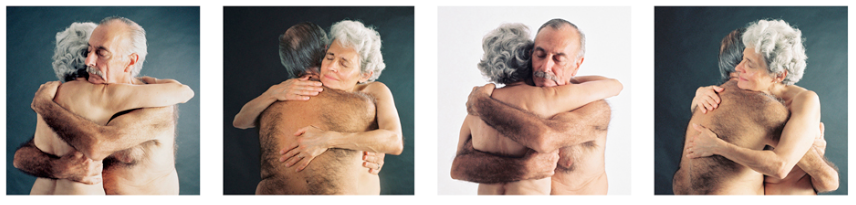
| Simbiosis / Symbiosis (Serie Las Cuatro Estaciones, 2013-2014) |
Cultural ReProducers: Briefly describe your children in your own words.
Ana: My eldest son is pure contemplation, beauty, and a mixture of fragility and strength. He inspires us by pushing our limits, making us face humility and embrace the lack of control, while letting us appreciate sublime mysteries. My daughter and my younger son are joy, curiosity, creativity, wit, endless possibilities, strength, assertiveness, freedom, collaboration, beauty and genuine empathy.
 |
| Anunciación / Anunciation (Serie Las Cuatro Estaciones, 2013-2014) |
Ana: I became an artist when I became a mother. My first son was born with a severe neurological condition, and with that experience I saw all of my certainties crash around me. We were in New York City and I was spending a lot of time caring for him and trying to do a very exhausting early intervention program while living far away from friends and family. Everything was so overwhelming and I was feeling so lonely that I started taking photographs as a way to cope. I needed to focus on the beauty of my son regardless of his challenges.
Combining my family life with my art has become something organic. My children are around during most of my photo shoots, and they also take part in my husband's projects (he is also an artist). We have decided to create a life together where there is no delineation between the art creation and family life. We travel together, mount exhibitions with the children around, and discuss new ideas at the dinner table.
The arts community and market has offered very little support. I have submitted a few of my projects to open calls which offer funding but curiously enough all the money had to be spent on the art production, so there is never money left for personal and family needs. My immediate community (which lately is mostly online) supports my art by giving visibility to what I do and by taking part in my projects. Over the years, with a broader recognition of my artwork, I am starting to participate in art festivals and exhibitions that have given their support not only economically but also logistically.
CR: At what point did you begin incorporating your children and other family members directly into your work?
Ana: Before focusing on photography and installation, I was working as a producer for Buenos Aires Television and also at PBS in New York City. I was mainly involved in the production of documentaries, so I was always intrigued by the recording of personal stories. From the moment I became pregnant for the first time I started documenting this transformative process. I was not pursuing any specific artistic or aesthetic goal, but the shift in priorities, learning about myself under a completely different perspective, was intriguing. Documenting that change was a tool to understand what I was going through and who I was becoming.
 |
| Sombra / Shadow (Serie Las Cuatro Estaciones, 2013-2014) |
Ana: My mothering is not a performance. The relationship I have with my children exists even if no one is looking. The reason I expose certain aspects of my mothering to the public is because I think that motherhood has been idealized, and only a very constricted version of birth and parenting has been exposed. I feel that it is important to contribute these experiences that have been banned or silenced, and that can expand the references that as a society we have about mothering. In my artwork I not only portray myself as a mother but as a daughter as well.
I have learnt a lot through each one of my empowering respected births, mothering a child with special needs and total dependency, having a late gestational loss (at home), raising a pre-teen girl,
and committing to freedom not through a selfish pursuit of independence but through the exercise of
chosen responsibility and generous love. I have met wonderful people who have told me they had abortions because they knew that their babies had certain anomalies and they could not imagine themselves coping with these difficulties. Although I am pro-choice, I also feel that in order to choose you need to have as much information as possible. You need to know that life can be wonderful and meaningful even when you are facing difficult challenges, and this is something that is not usually
told. The lack of horizontal and empathetic information makes for an easily manipulated society.
 Including my children in my work and my husband's work plays a role in their upbringing in the same way that it did for us to go to work with our own parents when we were young to help them in their non-artistic jobs. The importance is not in the kind of job that they are participating in, but in the quality time we share. The importance for any child is in realizing that their contribution is useful and appreciated. That they are part of something bigger. That they are important.
CR: The body, mostly but not exclusively female, has a central role in your discourse. Where does your interest in the body as a vessel and communicator of ideas come from? Do you think this interest has a direct connection with your motherhood?
Ana: I photograph the body, mainly female, to re-appropriate something that is ours and which has been used, ridiculed, violated, admired, judged, exploited, and objectified throughout history. How I relate to the body is a mirror of my fascination with life. I am accepting of my changing body, amazed by how my children grow, and intrigued by the aging process. I have enjoyed my pregnancies and have had joyful, intense home births. The blood and nudity seen within the context of my artwork is linked to this authenticity and undiluted sensuality.
I am interested in the body as territory: a place in which each life leaves its trace, not for its aesthetic value. Culturally, female bodily functions have been concealed and treated as something shameful. I expose blood in order to show that we are not objects, and to denounce the debilitation, domestication, and exploitation that women are often subjected to.
 |
| Ana Álvarez-Errecalde, My Parents, 2003 |
Ana: I took the photographs for El Nacimiento de mi Hija (The Birth of my Daughter, 2005) because I had a profound need to see this sort of maternity represented. While I was pregnant with my daughter, every time I would close my eyes to go to sleep, I had this recurring image of being connected to my baby by my umbilical cord. When I took these photographs it wasn't my intention to include them as part of my artistic work. I didn’t know if the home birth would allow me to capture these moments, I just wanted to do my best to create an image like the one that had enchanted me in my mind. When I saw the contact sheet (at that time I was still shooting film) I soon understood that these photographs had a universal importance that transcended the personal documentation of my experience. I was healthy, happy and lucid to the extent of being able to do a self portrait! I felt that these photographs could help others rethink the idea of the fragile, painful, out of control and overly medicated birth that is considered the norm, but it also goes beyond the occurrence to delve into deeper issues of our understanding of society, fear, and life. This is why it was important to share this and other projects in the context of the exhibition space.
 |
| El Nacimiento de mi Hija / Birth of my Daughter, 2005 |
CR: The photograph of your daughter’s birth has provoked strong reactions, for and against. What did you want to convey or express? Do you think people have understood?
Ana: With this diptych I wanted to contribute my experience to expand on the constrained social imagery of motherhood. My experience of childbirth is not unique: throughout history many women have had enjoyable, unmedicated, independent, and free births. However these stories have rarely been told. Circulating these self-portraits through arts and media contexts is my way of refuting the idea that childbirth is a divine punishment, an imminent danger, and a painful burden, which we need to free ourselves from. The intensity of labour has a purpose. The pain is proportional to the fear. Childbirth can be a rite of passage. Often I get messages from people from different parts of the world who thank me for sharing this intimate experience. There are also those who feel distaste and compare giving birth to other physiological processes, like defecating. For me this is indicative of the value we give to childhood and maternity. There are people who have had horrifying, abusive, or simply misinformed experiences of labour, and seeing these photographs can confront them with what their experience could have been but wasn't. Sometimes we hide away our sorrows and these images can act as a trigger to something we wish we could forget.
Though I am proud and thankful for many of the positive changes gained by the activism of the Feminist movement, much of this feminism from the last decades was responsible for putting motherhood in the closet. Maternal desire became seen as a failure and a weakness that hindered our creativity, intelligence and development. The natural expectations of babies, as mammals, were not taken into account. Medicine and the pharmaceutical industry rushed forward to offer anesthetized births and milk in bottles that freed the mother from the intrinsic dependence of her young. For me, violence towards women begins with the repression of sexuality, the appropriation of childbirth, the interference with all vital cycles and the creation of manipulative roles. A negated mother will also negate her body and her presence to her children, so they will all ultimately conform to our unattended, unloved, and unnourished society. This violence consists in promoting shortcomings that trigger a disproportionate consumerism that is perverse and unsustainable. A fulfilled woman who accepts her body and finds pleasure in sharing it with her offspring is a revolution in her own right, because she stops being part of a establishment that feeds the enormous unsatisfied needs of future men and women.
 |
| from the series, CESAREAN, beyond the Wound, 2009 |
* * * * * * * * * * * * * * * * * * * * * * * * * * * * *
Irene Pérez is a visual artist now living and working near Barcelona, Spain. She shares her life with a passionate physicist, their vibrant five-year-old daughter, and a black cat named Nit. Irene is currently working on the project New Universe; a series of works that explore the learning processes occurring within a family. New Universe will open in fall 2016 as an exhibition, lecture series and workshops at the Documentation Center and Textile Museum of Terrassa, Spain.


